
In industrial pipeline procurement, especially for large-diameter and high-pressure transmission projects, two common abbreviations frequently appear: SSAW (Spiral Submerged Arc Welded pipe) and LSAW (Longitudinal Submerged Arc Welded pipe).
Although both are welded steel pipes produced using the submerged arc welding (SAW) process, their manufacturing methods are fundamentally different, which leads to significant differences in performance, cost, and application scenarios. As a result, many project decision-makers often struggle with a key question: which pipe type is truly suitable for my project? Choosing an overly expensive option wastes budget, while selecting the wrong one may compromise engineering safety.
This article provides a clear, practical comparison to help you make a well-informed procurement decision.
I. How Are They Manufactured?
1. SSAW (Spiral Submerged Arc Welded Pipe)
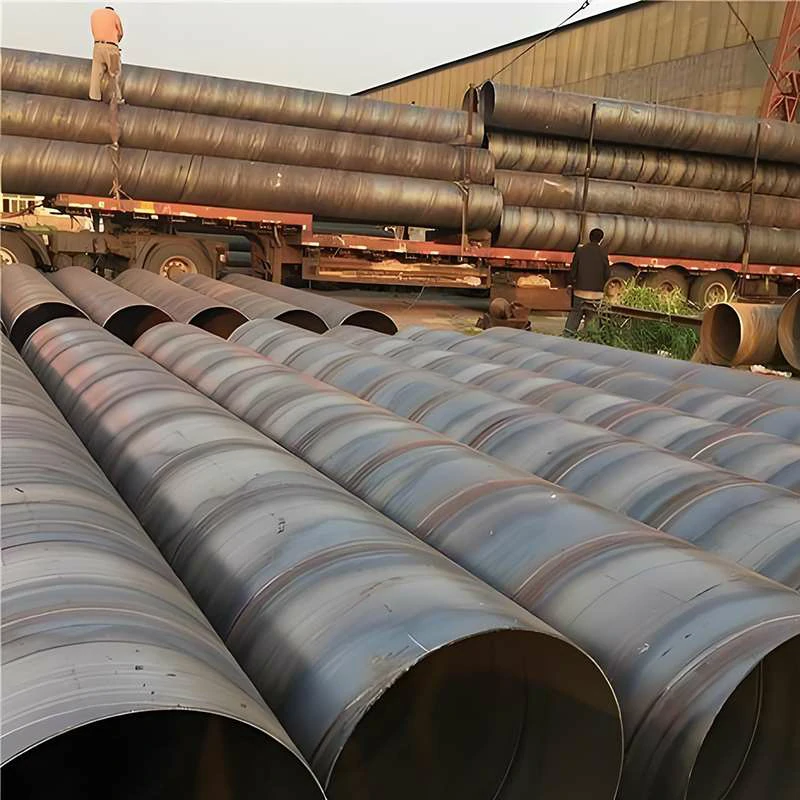
SSAW pipes are manufactured from steel coils (strip steel). The strip is continuously uncoiled and formed into a tube at a spiral angle, similar to wrapping paper around a cylinder. The spiral seam is then welded along its entire length.
Key characteristics:
- Uses relatively narrow steel strip to produce large-diameter pipes
- Diameter can be adjusted by changing the forming angle
- Continuous production process with high efficiency
2. LSAW (Longitudinal Submerged Arc Welded Pipe)
LSAW pipes are produced from single heavy steel plates. Each plate is pressed in large forming machines into J-, U-, O-, or E-shapes until it becomes a cylindrical pipe. The straight longitudinal seam is then welded.
Key characteristics:
- One steel plate forms one pipe (non-continuous production)
- Often requires mechanical expansion (hydro/mechanical expansion) after welding to improve roundness and dimensional accuracy
- Excellent control of wall thickness uniformity and geometric precision
II. Performance Comparison: Strengths and Weaknesses
1. Pressure resistance and safety performance: LSAW is superior
LSAW advantage (higher safety level):
- The weld seam is a straight longitudinal line, parallel to the main stress direction of the pipeline
- Manufactured from hot-rolled medium/thick steel plates with better material uniformity than coil-based SSAW
- After mechanical expansion, internal residual stress is significantly reduced
SSAW limitation:
- Weld seam follows a long spiral path
- Internal pressure generates circumferential stress that acts more severely on the spiral weld
- No mechanical expansion in most cases, resulting in higher residual stress
- If steel strip quality is inconsistent, long-distance high-pressure operation increases the risk of seam failure or tearing
2. Size and specification range: each has advantages
Wall thickness (LSAW advantage):
- LSAW pipes can be manufactured with very thick plates
- Wall thickness can exceed 40 mm or even 60 mm in heavy-duty applications
- SSAW pipes are limited by strip forming capacity and equipment constraints, typically ≤25 mm in mainstream production
Diameter and length (SSAW advantage):
- SSAW supports continuous production and flexible cutting lengths (commonly up to 12 m for transportation limits)
- Large diameters (2 m, 3 m or more) can be produced using relatively narrow strip steel
- LSAW is limited by plate size; extremely large diameters may require plate splicing, introducing additional weld seams
3. Cost and delivery time: SSAW is clearly more competitive
Cost advantage (SSAW):
- Uses steel coils, which are typically cheaper than heavy plates used for LSAW
- High production efficiency and lower labor cost
- Under the same specification and material grade, SSAW is significantly cheaper per ton
Delivery advantage (SSAW):
- Faster production cycle, suitable for urgent or bulk orders
- LSAW involves more complex forming, welding, and expansion processes, resulting in longer lead times
III. Application Matching Guide
Procurement is not about choosing the “best” pipe, but the most suitable one for the project.
| Project Type | Recommended Pipe | Reason |
|---|---|---|
| Water supply, sewage, agricultural irrigation | SSAW pipe (first choice) | Low internal pressure (typically only a few to tens of bar). SSAW provides excellent cost efficiency and sufficient performance |
| High-pressure natural gas & long-distance oil pipelines | LSAW pipe (first choice) | High-risk, high-pressure systems. Industry standards such as API 5L strongly recommend LSAW for critical pipelines |
| High-rise piling & bridge structural support | Depends on case | SSAW is sufficient for general piling; LSAW is preferred for critical load-bearing columns requiring high roundness and strength |
| Power plant circulating water & low-pressure chemical pipelines | SSAW pipe | Cost-effective solution; budget can be allocated to anti-corrosion systems such as 3PE coating or internal epoxy lining |
IV. Four Practical Tips for Procurement Managers
When making purchasing decisions, focus on real engineering and economic factors rather than nominal unit price alone.
1. Evaluate total tonnage cost, not unit price
LSAW pipes are more expensive per ton, but may allow thinner wall design due to higher steel grade and engineering optimization.
SSAW pipes are cheaper per ton, but often require thicker walls for safety margins.
Practical approach:
Request suppliers to quote total project cost based on design specifications for both options. In many cases, the total cost difference is smaller than expected.
2. Consider on-site welding efficiency
LSAW pipes, after mechanical expansion, have excellent roundness, making field joint alignment easier and faster.
SSAW pipes may exhibit slight ovality or edge deformation, which can increase alignment difficulty and welding labor cost on-site.
3. Account for anti-corrosion system cost
Large-diameter pipelines often require external 3PE anti-corrosion coating or internal epoxy lining.
- SSAW pipes, due to spiral weld seams, may cause coating thickness inconsistency at the weld area
- LSAW pipes have smoother surfaces, resulting in more uniform coating quality and better coating acceptance rates
4. Verify manufacturer qualifications
Regardless of pipe type, supplier qualification is critical.
Ensure the manufacturer holds:
- Special Equipment Manufacturing License (pressure pipeline components)
- API 5L certification (for oil and gas pipelines)
For SSAW pipes in particular, full NDT (Non-Destructive Testing) reports must be required, including X-ray or ultrasonic inspection, as weld defects such as porosity or slag inclusion are key risk factors.
Conclusion
SSAW and LSAW pipes are not simply “better or worse” options—they are engineered solutions for different working conditions.
- SSAW: cost-efficient, ideal for low-to-medium pressure and large-diameter applications
- LSAW: high-strength, high-precision, designed for critical high-pressure systems
A rational procurement decision should always be based on engineering requirements, lifecycle cost, and installation conditions rather than unit price alone.