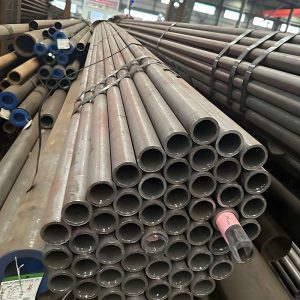
I. What Is a Seamless Carbon Steel Pipe?
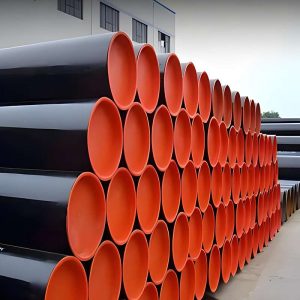
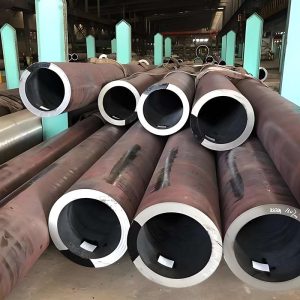
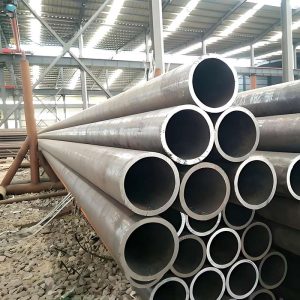
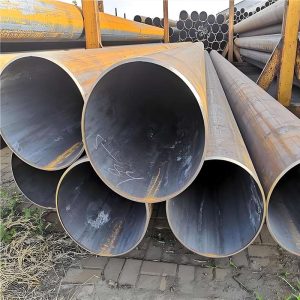
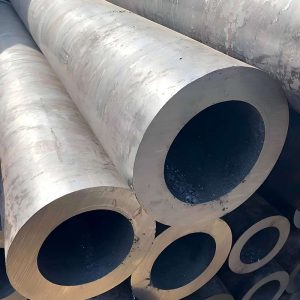
A seamless carbon steel pipe is a type of steel pipe that has no welded seams. It is manufactured directly from a solid round steel billet through processes such as piercing, hot rolling, cold rolling, or cold drawing.
Compared with welded steel pipes, seamless carbon steel pipes have a more uniform structure, which gives them higher pressure resistance and better mechanical properties. As a result, they are widely used in high-pressure, high-temperature, and critical fluid transportation systems.
Common classifications of seamless carbon steel pipes
| Production Method |
Features |
Applications |
| Hot Rolled Seamless Pipe |
Rolled above the steel recrystallization temperature (red-hot condition). High production efficiency and relatively low cost. Usually has thicker wall thickness. |
Commonly used for pipeline transportation and general structural applications. |
| Cold Drawn / Cold Rolled Seamless Pipe |
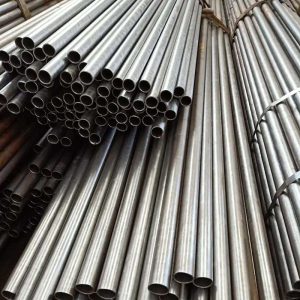
Secondary processing of steel pipes at room temperature through drawing or rolling. Smoother surface finish, higher dimensional accuracy, and thinner wall thickness. |
Widely used for automotive components, precision machinery parts, and small-diameter high-pressure pipes. |
II. Seamless carbon steel pipe manufacturing process
- Hot-rolled seamless steel pipe manufacturing process:
Round steel billet → Heating → Piercing → Hot rolling → Sizing → Cooling → Straightening → Cutting → Inspection → Finished product
- Cold-drawn seamless steel pipe manufacturing process:
Hot-rolled tube → Pickling → Lubrication → Cold drawing → Heat treatment → Straightening → Inspection → Finished product
- Cold-rolled seamless steel pipe manufacturing process:
Hot-rolled tube → Pickling → Cold rolling → Annealing → Sizing → Inspection → Finished product
| Comparison Item |
Hot Rolled Seamless Steel Pipe |
Cold Drawn Seamless Steel Pipe |
Cold Rolled Seamless Steel Pipe |
| Manufacturing Process |
Formed by hot rolling |
Formed by cold drawing |
Formed by cold rolling |
| Dimensional Accuracy |
Standard |
Higher |
High |
| Surface Finish |
Relatively rough |
Smoother |
Very smooth |
| Wall Thickness Uniformity |
Standard |
Better |
Good |
| Mechanical Properties |
Good |
Better |
Excellent |
| Production Cost |
Lower |
Higher |
High |
| Production Efficiency |
High |
Medium |
Lower |
| Common Sizes |
Medium and large diameters |
Small and medium diameters |
Small diameters |
| Typical Applications |
General industrial pipelines |
Hydraulic systems and machining |
Precision equipment and automotive parts |
| Main Advantages |
Low cost and high output |
High precision and smooth surface |
High precision and superior quality |
| Main Disadvantages |
Lower precision |
Higher cost |
Complex process and higher price |
III. Commonly used standards for seamless carbon steel pipes
| Standard |
Standard Name |
Country / Region |
Main Applications |
| ASTM A53 |
Seamless and Welded Steel Pipe |
USA |
General fluid transportation and structural applications |
| ASTM A106 |
Seamless Carbon Steel Pipe for High-Temperature Service |
USA |
High-temperature and high-pressure fluid transportation |
| ASTM A179 |
Seamless Cold-Drawn Low-Carbon Steel Tubes |
USA |
Heat exchangers and condensers |
| ASTM A192 |
Seamless Boiler Tubes for High Pressure Service |
USA |
High-pressure boiler tubes |
| ASTM A210 |
Medium-Carbon Seamless Boiler Tubes |
USA |
Boilers and superheaters |
| API 5L |
Line Pipe Standard |
USA |
Oil and natural gas pipeline transportation |
| EN 10216 |
Seamless Steel Tubes for Pressure Purposes |
Europe |
Pressure piping systems |
| DIN 17175 |
Heat-Resistant Seamless Steel Tubes |
Germany |
High-temperature boilers and thermal equipment |
| JIS G3454 |
Carbon Steel Pipes for Pressure Service |
Japan |
Pressure piping |
| JIS G3456 |
Carbon Steel Pipes for High Temperature Service |
Japan |
High-temperature fluid transportation |
| GB/T 8163 |
Seamless Steel Pipes for Fluid Transport |
China |
General fluid transportation |
| GB/T 3087 |
Seamless Steel Tubes for Low and Medium Pressure Boilers |
China |
Low and medium pressure boilers |
| GB/T 5310 |
Seamless Steel Tubes for High Pressure Boilers |
China |
High-pressure boiler systems |
Common Standard Application Notes
| Application Field |
Common Standards |
| Oil and Gas Pipelines |
API 5L, ASTM A106 |
| High-Temperature Steam Systems |
ASTM A106, DIN 17175 |
| Boiler Systems |
ASTM A192, GB/T 5310 |
| General Fluid Transportation |
ASTM A53, GB/T 8163 |
| Heat Exchangers |
ASTM A179 |
| European Market Projects |
EN 10216 |
| Japanese Market Projects |
JIS G3454, JIS G3456 |
IV. Common materials for seamless carbon steel pipes
| Standard System |
Common Materials / Steel Grades |
Features |
Main Applications |
| ASTM |
ASTM A53 Gr.A / Gr.B |
General-purpose carbon steel material |
General fluid transportation and structural applications |
| ASTM |
ASTM A106 Gr.B / Gr.C |
Resistant to high temperature and high pressure |
Steam and high-temperature pipelines |
| API |
API 5L Gr.B, X42, X52, X60 |
High strength |
Oil and natural gas transportation |
| GB |
20# |
Good plasticity and weldability |
General fluid transportation |
| GB |
Q235B |
Low cost |
Building structures and low-pressure transportation |
| GB |
Q345B |
Higher strength |
Engineering structures and machinery manufacturing |
| EN |
P235TR1, P265TR1 |
European pressure pipe steel grades |
Pressure piping systems |
| DIN |
ST35, ST45, ST52 |
German standard steel grades |
Machining and hydraulic systems |
| JIS |
STPG370, STPG410 |
Japanese pressure pipe steel grades |
Pressure fluid transportation |
V. Main application areas of seamless carbon steel pipes
1. Oil and Gas Transportation
If your project involves:
- Oil transportation
- Natural gas pipelines
- Oil and gas extraction
- Long-distance pipeline projects
You will typically need to select:
- API 5L Gr.B
- API 5L X42 / X52
- ASTM A106 Gr.B
These types of steel pipes require:
- High pressure resistance
- Good toughness
- Suitable for complex environments
- Suitable for long-term continuous operation
2. High-Temperature Steam and Boiler Systems
If your system involves:
- Steam transmission
- Boiler piping
- Power plants
- High-temperature thermal systems
Recommended choice:
- ASTM A106 Gr.B
- ASTM A192
- ASTM A210
- GB/T 5310
Because ordinary steel pipes are prone to the following issues at high temperatures:
- Strength reduction
- Deformation
- Aging
3. General Fluid Transportation
If used only for:
- Water transportation
- Air transportation
- General industrial fluids
- Fire protection piping
Typically, the following standards can be selected:
- ASTM A53
- GB/T 8163
- 20# seamless steel pipe
4. Chemical Industry
Chemical pipelines typically face:
- High temperature
- High pressure
- Corrosive media
Therefore, it is recommended to choose:
- ASTM A106
- Q345B
- Seamless corrosion-resistant steel pipe
If the transported medium is corrosive, the following should also be added:
- Epoxy coating
- 3PE anti-corrosion
- Internal anti-corrosion lining
5. Building and Engineering Structures
If the steel pipes are mainly used for:
- Steel structures
- Building supports
- Bridge engineering
- Piling engineering
The following are commonly chosen:
Among them:
- Q235B has a lower cost
- Q345B has higher strength
VI. How to choose the right seamless carbon steel pipe
1. First, determine your operating environment.
- What medium will be transported?
- What is the operating temperature?
- What is the operating pressure?
- Is there any corrosion?
- Is high precision required?
Different operating conditions require completely different steel pipes.
2. Selecting Steel Pipes Based on the Transport Medium
i. Ordinary water, air, low-pressure fluids
For:
- Water transport
- Air transport
- General industrial fluids
- Fire protection systems
Typically, you can choose:
- ASTM A53
- GB/T 8163
- 20# seamless steel pipe
Features:
- Lower cost
- Fast delivery
- Meets general industrial needs
ii. Oil and Gas Transportation
For applications involving:
- Natural Gas Pipelines
- Oil Transportation
- Long-Distance Pipelines
Recommended selection:
- API 5L Gr.B
- API 5L X42 / X52
- ASTM A106 Gr.B
Because oil and gas pipelines prioritize:
- Pressure resistance
- Toughness
- Safety
- Service life
iii. Steam, High-Temperature Media
If the pipeline is exposed to a high-temperature environment for extended periods:
- Steam systems
- Boiler systems
- Power plants
Recommended standards:
- ASTM A106 Gr.B
- ASTM A192
- ASTM A210
- GB/T 5310
Because ordinary steel pipes are prone to:
- Strength reduction
- Deformation
- Cracking at high temperatures
iv. Corrosive Media
If transporting:
- Chemical Media
- Acids and Alkalis
- Seawater
Besides selecting seamless steel pipes, corrosion protection must also be considered.
Common Solutions:
- 3PE Anti-corrosion
- Epoxy Coating
- Zinc Plating
- Internal Lining for Corrosion Protection
Otherwise, even if the steel pipe has sufficient strength, it may corrode and fail quickly.
3. Choose based on work pressure
i. High-Pressure Systems
If it belongs to:
- High-Pressure Steam
- High-Pressure Oil/Gas
- Hydraulic Systems
Preferred Options:
- Seamless Steel Pipes
- Thick-Walled Steel Pipes
- High-Strength Steel Grade
Because seamless steel pipes have no weld seams:
- Stronger Pressure Resistance
- Higher Safety
- Lower Leakage Risk
ii. Low-pressure systems
For standard low-pressure water supply:
- Circulating water
- Drainage
- Ventilation systems
High-cost seamless steel pipes are not always necessary.
Sometimes welded steel pipes are more economical.
4. Select materials based on the usage environment
i. Normal Environments
Common Choices:
Suitable for most general industrial applications.
ii. High Strength Requirements
If Required:
- Higher Strength
- Greater Pressure Resistance
Optional Options:
- Q345B
- API 5L X52
- ASTM A106
Marine or Outdoor Environments
iii. Recommended Additions:
- Corrosion Protection
- Zinc Plating
- 3PE Coating
Because ordinary carbon steel is prone to rust.
V. How to choose the right seamless carbon steel pipe(FAQ)
Q1: How should I choose between seamless steel pipes and welded steel pipes?
This mainly depends on the working pressure and the usage environment.
For:
- High-pressure systems
- High-temperature steam
- Oil and gas
- Boiler systems
- Hydraulic equipment
Seamless steel pipes are generally recommended because they have no welds, resulting in higher overall strength and better pressure resistance.
For:
- Ordinary water transportation
- Low-pressure fluids
- Building structures
- Ordinary fire protection systems
Welded steel pipes are often more economical and can effectively reduce procurement costs.
In short:
- High pressure, high temperature → Seamless steel pipes
- Ordinary low pressure → Welded steel pipes
Q2: Is thicker wall thickness always better for seamless steel pipes?
Not necessarily.
Many people believe that thicker walls are safer, but in reality:
- Excessive wall thickness increases cost
- It increases weight
- It makes installation more difficult
- It can sometimes affect flow rate
The correct approach is to calculate the appropriate wall thickness based on:
- Operating pressure
- Operating temperature
- Pipe diameter
- and applicable standards.
For example:
- High-pressure steam systems require thick-walled pipes,
- but using excessively thick steel pipes in ordinary water supply systems is a waste of resources.
Q3: What material should be selected for high-temperature environments?
For applications requiring long-term exposure to high temperatures, such as:
- Steam systems
- Boiler piping
- Power plants
Recommended materials:
- ASTM A106 Gr.B
- ASTM A192
- ASTM A210
- GB/T 5310
Because ordinary carbon steel is prone to:
- strength reduction
- deformation
- aging at high temperatures
High-temperature specialized steel pipes can operate more stably and safely over long periods.
Q4: Is seamless steel pipe sufficient for transporting corrosive media?
No.
While seamless steel pipes are strong, ordinary carbon steel itself is not corrosion-resistant.
If transporting:
- Acidic or alkaline media
- Chemical liquids
- Seawater
- Moist media
Additional anti-corrosion measures are usually required, such as:
- 3PE anti-corrosion coating
- Epoxy coating
- Zinc plating
- Internal anti-corrosion lining
Otherwise, the steel pipe may quickly rust or even leak.
Q5: How to choose between hot-rolled, cold-drawn, and cold-rolled seamless steel pipes?
It mainly depends on your requirements for precision and application.
i. Hot-rolled seamless steel pipes
Suitable for:
- General industrial pipelines
- Large-diameter conveying
Features:
- Low cost
- High output
- Moderate precision
ii. Cold-drawn seamless steel pipes
Suitable for:
- Hydraulic equipment
- Machining
Features:
- High precision
- Smoother surface
iii. Cold-rolled precision steel pipes
Suitable for:
- Automotive parts
- Precision instruments
Features:
- High precision
- High surface quality
For general conveying, hot-rolled steel pipes are usually sufficient.
Q6: What are the most important parameters when purchasing seamless steel pipes?
Many purchasers only provide the "pipe diameter," which is far from sufficient.
It is recommended to confirm at least the following parameters:
- Outer Diameter (OD)
- Wall Thickness (WT)
- Length
- Material
- Standards Applied to
- Working Pressure
- Working Temperature
- Transporting Medium
- Corrosion Protection Required
- Third-Party Testing Required
Especially for export projects or engineering projects, standards and testing requirements are crucial.
If parameters are unclear, the following problems can easily occur:
- Size Mismatch
- Insufficient Pressure Bearing Capacity
- Failure to Pass Acceptance
- Rework Later
Therefore, clarifying the operating conditions before selection is more important than simply comparing prices.

-4-300x300.jpg)
-1-300x300.jpg)