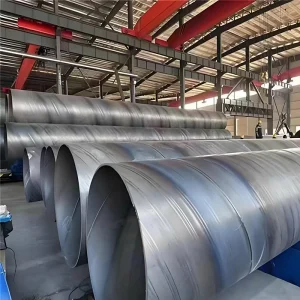
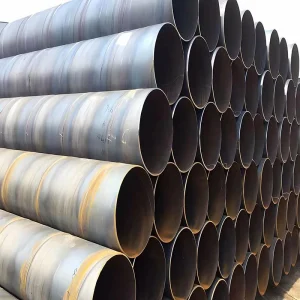
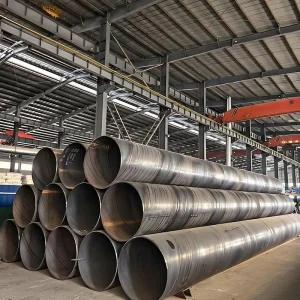
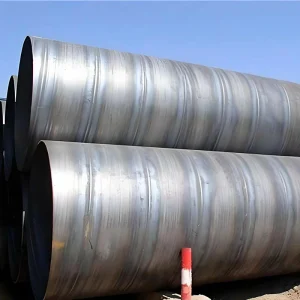
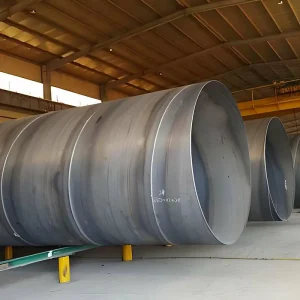
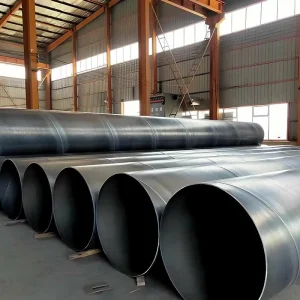
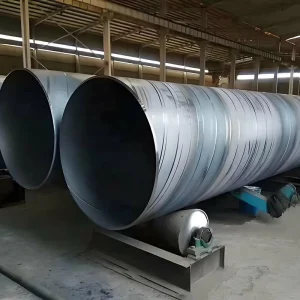
I. What is Spiral Steel Pipe (SSAW)?
Spiral Steel Pipe is produced by forming low-carbon structural steel or low-alloy steel strip into a cylindrical shape at a specific spiral angle, and then welding the seam using a submerged arc welding process.
Thanks to this unique manufacturing method,
SSAW pipes can be produced in large diameters using relatively narrow steel strips, making them highly efficient and cost-effective for large-scale pipeline applications.
Below is a detailed overview of spiral welded steel pipes:
II. Spiral Welded Steel Pipe Manufacturing Process
1. Raw Material Preparation and Pre-Treatment
Prior to formal production, it is essential to ensure that the quality of the raw materials meets the relevant standards (such as API 5L or GB/T 9711).
- Uncoiling: Unwinding coiled steel strip and performing preliminary flattening.
- Plate Ultrasonic Inspection: Performing ultrasonic testing on the steel strip entering the production line to ensure there are no internal cracks or inclusions in the plate.
- Edge Milling: Using an edge milling machine to process both edges of the steel strip to achieve the required width, parallelism, and a groove shape suitable for welding.
2. Spiral Forming Stage
This is the most critical step in the manufacturing process.
- Feed Control: The steel strip is fed into the forming machine via feed rollers.
- Spiral Forming: The forming machine curls the flat steel strip into a tubular shape by adjusting the angle of the rollers (forming angle). The size of the forming angle determines the diameter of the steel tube.
3. Welding Process (Double-Sided Submerged Arc Welding)
Spiral welded steel pipes are manufactured using double-sided submerged arc welding (SAW) to ensure high weld strength.
- Internal Welding: Starting from the rear of the forming point, automatic submerged arc welding is first performed on the inside of the steel pipe.
- External Welding: Immediately after the internal welding is completed, welding is performed on the outside of the steel pipe to form a robust double-sided weld.
4. Cutting and Post-Processing
- In-line Cutting: Using plasma or waterjet cutting, continuously produced steel pipes are cut to the required lengths.
- Visual Inspection: Technicians conduct a preliminary inspection of the weld appearance and the geometric dimensions of the steel pipes.
5. Inspection and Quality Control (Multiple Safeguards)
To ensure the safety of industrial and pressure pipelines, the following rigorous tests must be conducted:
- Ultrasonic Testing: An automated ultrasonic testing device scans 100% of the welds to check for porosity, slag inclusions, or lack of fusion.
- X-Ray Inspection: X-ray imaging is performed on areas where defects were detected by ultrasonic testing or on critical welds to verify internal quality.
- Hydrostatic Testing: The steel pipe is sealed and filled with high-pressure water to test its pressure-bearing capacity and seal integrity at specified pressures, ensuring there are no leaks.
6. Final Finishing and Delivery
- Pipe End Processing (Beveling): The ends of the steel pipes are beveled to facilitate butt welding during on-site construction.
- Corrosion Protection (Coating): Depending on customer requirements, anti-corrosion paint or varnish is applied, or external corrosion protection treatments such as 3PE or FBE are performed.
- Marking and Warehousing: Specifications, steel grade, standards, and production batch numbers are spray-painted onto the pipe body.
III. Application areas of spiral welded steel pipe
1. Energy Transportation
- Oil and Gas: Used in gathering and transmission pipelines for oil and gas fields, as well as long-distance onshore pipelines. In compliance with the API 5L standard, these pipelines transport crude oil and natural gas over long distances to refineries or urban gas distribution stations.
- Pulverized Coal Transportation: Used in coal preparation plants or power plants to transport solid-liquid mixtures such as coal slurry.
2. Water Resources and Municipal Engineering
- Urban Water Supply: As the preferred choice for urban water mains, these pipes typically feature an interior coating of potable-grade epoxy resin (IPN8710) and a 3PE anti-corrosion coating on the exterior.
- Drainage and Sewage: Used in urban sewage collection systems, stormwater drainage, and pressure pipelines for large pumping stations.
- Agricultural Irrigation: Used in long-distance water conveyance projects; due to the long single-pipe lengths (typically 12 meters), the number of on-site welds can be reduced, thereby lowering costs.
3. Infrastructure and Structural Engineering
- Piling Pipes: Widely used for support piles in bridges, docks, high-rise buildings, and road infrastructure.
- Building Structures: Used for steel structural frameworks in large stadiums and airport terminals.
- Billboards and Streetlight Poles: Due to their aesthetic appeal and wide range of specifications, they are also commonly used for urban landscape support.
4. District Heating Projects (Insulated Pipe Cores)
In district heating systems in northern cities, spiral steel pipes form the core of prefabricated, pre-insulated pipes:
- They serve as the inner pipe for transporting hot water or steam.
- Combined with an outer layer of polyurethane foam insulation and a high-density polyethylene (HDPE) outer casing, they enable highly efficient heat transfer.
5. Industrial Circulation Systems
- Power Plant Circulating Water: Cooling circulation water systems in thermal and nuclear power plants.
- Chemical Industry: Conveying non-corrosive or low-corrosive industrial fluids.
- Dredging Projects: Slurry conveyance pipes used for clearing ports and waterways (land reclamation projects).
IV. Differences Between Spiral Steel Pipe, LSAW, and ERW
| Main Parameters |
SSAW Spiral Steel Pipe |
LSAW Longitudinal Submerged Arc Welded Pipe |
ERW High Frequency Welded Pipe |
| Weld Seam Type |
Spiral Weld Seam |
Longitudinal Weld Seam |
Longitudinal Weld Seam |
| Manufacturing Process |
Submerged Arc Welding |
Submerged Arc Welding |
High Frequency Resistance Welding |
| Raw Material |
Steel Coil |
Steel Plate |
Steel Coil |
| Diameter Range |
Large Diameter |
Large Diameter |
Small to Medium Diameter |
| Wall Thickness Range |
Medium to Thick Wall |
Thick Wall |
Thin to Medium Wall |
| Pressure Capacity |
Good |
High |
Medium |
| Dimensional Accuracy |
Standard |
High |
High |
| Production Efficiency |
High |
Medium |
High |
| Manufacturing Cost |
Lower |
Higher |
Lower |
| Main Applications |
Water Transmission, Oil & Gas, Municipal Pipelines |
High-Pressure Oil & Gas Transmission |
Structural Pipe, Fluid Transportation |
V. Why choose our spiral steel pipes?
1. Comprehensive Manufacturing Capabilities and Full Range of Specifications
We operate multiple spiral submerged arc welding production lines capable of meeting the diverse needs of various projects:
- Wide Diameter Range: We produce a variety of large-diameter steel pipes ranging from 219 mm to 3,020 mm in diameter.
- Custom Thickness: Wall thicknesses can reach up to 25.4 mm, meeting the stringent requirements of high-pressure transportation and structural support applications.
- Flexible Production: Leveraging the advantages of spiral forming technology, we can quickly adjust production plans to meet your specific order requirements.
2. Strict Adherence to International Quality Standards
We fully recognize the importance of industrial safety, and all our products strictly comply with globally recognized standards:
- Oil and Gas Applications: Strict adherence to API Spec 5L (PSL1 & PSL2) standards ensures the high reliability of pipeline steel.
- Structural and Water Supply/Drainage: Compliant with ASTM A252, EN 10219, GB/T 9711, and SY/T 5037.
- End-to-End Quality Inspection: Every steel pipe must undergo 100% ultrasonic testing, X-ray sampling, and hydrostatic testing to ensure zero defects upon shipment.
3. One-Stop Corrosion Protection Services
To extend the service life of steel pipes in harsh environments, we offer professional, integrated corrosion protection solutions:
- External Corrosion Protection: Includes state-of-the-art 3PE (three-layer polyethylene), FBE (fusion-bonded epoxy powder), and epoxy coal tar coatings.
- Internal Lining: We offer potable water-grade IPN8710 coatings, liquid epoxy coatings, and cement mortar linings.
- Thermal Insulation: For heating projects, we provide pre-insulated polyurethane pipes for direct burial.
4. Extensive Experience in the Middle East and Global Markets
We have extensive export experience, particularly in Middle Eastern markets such as the United Arab Emirates and Saudi Arabia:
- Familiarity with Standards: In-depth understanding of the specific technical specifications for oil and gas and water projects in the Middle East.
- Logistics Support: We have established long-term partnerships with major global freight forwarders, enabling us to offer highly competitive ocean freight rates and efficient delivery times.
- Website Optimization and Digital Communication: We provide comprehensive online technical documentation and real-time quotes to ensure seamless communication.
5. Highly Competitive Value for Money
- Raw Material Advantages: Located in major steel production hubs, we are able to source high-quality steel strips at more favorable prices.
- Large-Scale Production: Automated production processes significantly enhance efficiency and reduce per-pipe production costs, which are directly passed on to our customers.
VI. FAQ on the Procurement and Selection of Spiral Welded Steel Pipes
Q1: How should I choose between spiral welded steel pipes (SSAW) and straight seam welded steel pipes (LSAW/ERW)?
A: It mainly depends on the pipe diameter and your budget.
- If you need large-diameter pipes (diameter > 610 mm) and have a limited budget, spiral welded steel pipes offer the best value for money.
- For ultra-high-pressure oil and gas trunk lines, LSAW is typically the preferred choice.
- For routine fluid transportation involving small to medium diameters (diameter < 610 mm), ERW offers higher efficiency and lower costs.
Q2: Why is there such a significant price difference among spiral welded steel pipes?
A: Prices are primarily influenced by three key factors:
- Raw material (steel strip) grade: Q235B, Q355B, and higher-grade API 5L X60 have different costs.
- Applicable Standards: Pipes manufactured to the Ministry of Petroleum standard (SY/T 5037) are cheaper than those made to the Chinese National Standard (GB/T 9711) or the American Standard (API 5L), as the latter two impose stricter requirements for non-destructive testing and material composition.
- Corrosion Protection: There is a significant price difference between bare pipes and those treated with 3PE, FBE, or epoxy lining.
Q3: How can we ensure the weld quality of purchased spiral welded steel pipes is reliable?
A: It is essential to verify the manufacturer’s non-destructive testing (NDT) reports.
The standard inspection process should include:
- 100% in-line ultrasonic testing: To check for internal porosity or inclusions in the weld.
- X-ray sampling: To perform radiographic verification on critical areas (especially pipe ends).
- Hydrostatic pressure testing: Each pipe must undergo pressure testing to ensure it does not leak or burst under high pressure.
Q4: What are the specific standard requirements for export projects (such as those for the Middle East market)?
A: In international trade, API Spec 5L is the most widely used standard.
- It is necessary to confirm whether the project requires PSL1 or PSL2 grade (PSL2 has mandatory requirements for impact toughness and chemical composition, and destructive testing must be performed on each individual pipe).
- For Middle Eastern environments, steel pipes are typically required to have extremely strong UV resistance and high-temperature corrosion resistance; for example, 3PE anti-corrosion coatings must comply with the DIN 30670 standard.
Q5: Can the fixed length of spiral welded steel pipes be customized?
A: Yes. Although the standard fixed length is typically 12 meters (for ease of transport by container and truck), as a manufacturer, we can produce any length between 6 and 18 meters to meet project requirements.
- Note: Extra-long pipes (over 11.8 meters) may be difficult to load into a standard 40-foot container and typically require transport by bulk carrier.
Q6: Why is wall thickness tolerance important when selecting pipe specifications?
A: In actual production, steel pipe wall thickness often has positive and negative tolerances.
- In the design of pressure pipelines, if the actual wall thickness falls below the minimum design value, it may pose a safety hazard.
- When purchasing, you should explicitly require compliance with “tolerance standards.” For example, API 5L Spiral Steel Pipe imposes strict percentage limits on wall thickness, whereas standard water supply pipes may allow slightly larger negative tolerances. Clearly defining tolerances can prevent compliance disputes during subsequent acceptance inspections.