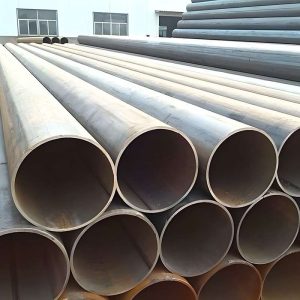
I. What is a Welded Carbon Steel Pipe?
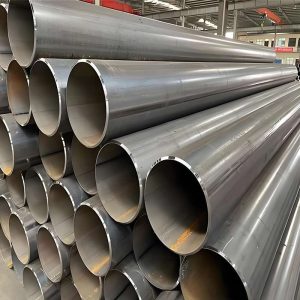
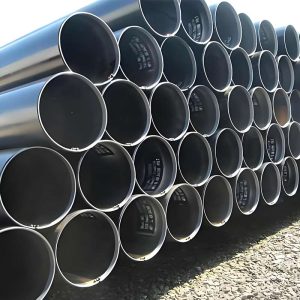
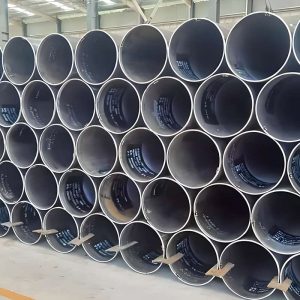
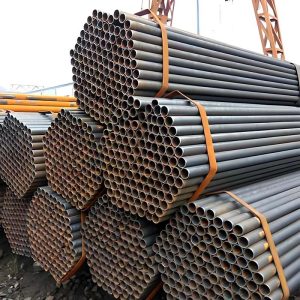
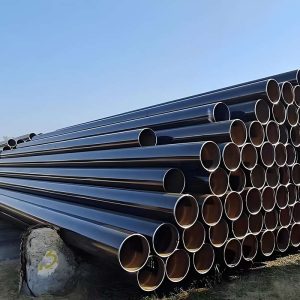
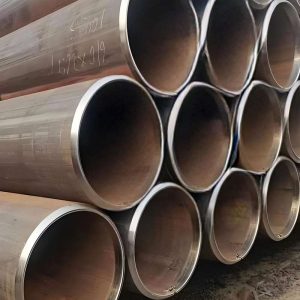
Welded Carbon Steel Pipe is a type of steel pipe made from carbon steel, formed by rolling steel plates or strips and then welding them together.
Depending on the welding method, common types include:
| Type |
Abbreviation |
Features |
| Electric Resistance Welded Pipe |
ERW Pipe |
Straight weld seam and high dimensional accuracy |
| Spiral Submerged Arc Welded Pipe |
SSAW Pipe |
Suitable for large diameter production |
| Longitudinal Submerged Arc Welded Pipe |
LSAW Pipe |
High strength and suitable for high-pressure transmission |
II. Manufacturing Process of Welded Carbon Steel Pipe
i. Different manufacturing processes
1. ERW (High-Frequency Straight Seam Welded Pipe) Process Flow:
Steel coil uncoiling → Leveling → Edge trimming → Forming (circular rolling) → High-Frequency welding → Removal of internal and external weld beads → Sizing → Cooling → Cutting to length → Non-destructive testing → Surface treatment → Finished product warehousing
Steel coil uncoiling → Leveling → Forming (spiral coiling) → Submerged arc welding (internal welding + external welding) → Weld inspection → Sizing and straightening → Pipe cutting → Hydrostatic test → Corrosion protection treatment → Finished product warehousing
3. LSAW (Straight Seam Submerged Arc Welded Pipe) Process Flow:
Steel plate leveling → Edge milling → UOE forming (or JCOE forming) → Internal and external submerged arc welding → Weld heat treatment → Ultrasonic testing → Sizing → Hydrostatic test → Pipe cutting → Corrosion protection treatment → Finished product warehousing
ii. Process flow description
1. ERW (High-Frequency Straight Seam Welded Pipe) Process
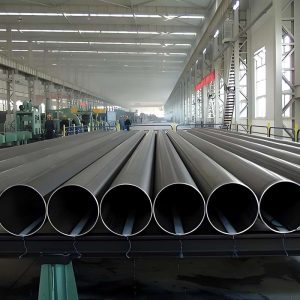
Description:The ERW process uses steel coils as raw material. Steel strips are continuously formed into round pipes, and then welded using heat generated by high-frequency current.
Features:
- High production efficiency
- Fine and high-precision weld seams
- Suitable for small and medium-diameter steel pipes
- Widely used in construction, water supply, and structural engineering.
2. SSAW (Spiral Welded Pipe) Process Description
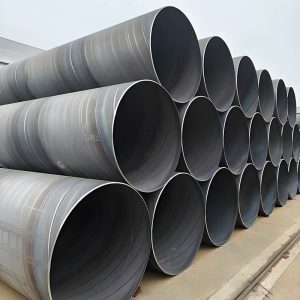
SSAW process involves rolling steel strip into a tubular shape at a spiral angle, followed by internal and external submerged arc welding.
Features:
- Can produce ultra-large diameter steel pipes
- High raw material utilization rate
- Relatively low cost
- Commonly used for water supply, piling, and long-distance oil and gas pipelines
3. LSAW (Straight Seam Submerged Arc Welded Pipe) Process Description
LSAW uses steel plates as raw material, forming straight seam pipes using UOE or JCOE forming methods, followed by submerged arc welding.
Features:
- High weld quality
- High strength and high pressure resistance
- Suitable for high-pressure transmission systems
- Commonly used in oil and gas pipeline projects
III. Application conditions and selection recommendations for welded carbon steel pipes
1. Municipal Water Supply and Transmission Systems
Application Conditions:
- Long-distance water transmission networks
- Underground buried environments
- Low-to-medium pressure transmission systems
- Long-term continuous operation
- Moist soil or environments with certain corrosiveness
Selection Recommendations:
- Recommended Types: ERW welded pipe or SSAW spiral welded pipe
- Common Standards: API 5L Gr.B, ASTM A53, Q235B / Q355B
- Corrosion Protection Requirements: 3PE or FBE corrosion protection is recommended (essential for buried systems)
Selection Notes:
- ERW is preferred for small diameters; SSAW is preferred for large diameters and long-distance water transmission.
2. Oil and Gas Transmission Engineering
Application Conditions:
- Long-distance high-pressure transmission
- Complex terrain (mountains, deserts, inter-regional pipelines)
- High safety requirements
- Continuous high-pressure operation
Selection Recommendations:
- Recommended Types: LSAW (Straight Seam Submerged Arc Welded Pipe) or High-Grade SSAW
- Common Standards: API 5L X42 / X52 / X60 / X65 / X70
- Corrosion Protection Requirements: 3PE / 3LPE or FBE reinforced corrosion protection
Selection Notes:
- LSAW is preferred for high-pressure trunk lines to ensure weld quality and structural safety.
3. Pile Foundation and Foundation Engineering
Application Conditions:
- Bridge, wharf, and building foundation piles
- High bearing capacity requirements
- Complex soil layers, potential impact loads
- Mostly large-diameter, thick-walled structures
Selection Recommendations:
- Recommended Type: SSAW spiral welded pipe
- Common Standards: ASTM A252, Q355B
- Corrosion Protection Requirements: Select ordinary black pipe or anti-corrosion coating based on soil environment
Selection Notes:
- SSAW is low-cost and suitable for large diameters, making it the mainstream choice for pile foundation engineering.
4. Building Structures and Steel Structures Engineering
Application Conditions:
- Steel structure supports, columns, frame structures
- Low to medium loads or non-compression applications
- Indoor or exposed structural environments
- High dimensional accuracy requirements
Selection Recommendations:
- Recommended Type: ERW welded pipe
- Common Standards: ASTM A500, ASTM A53, Q235B
- Corrosion Protection Requirements: Galvanized or spray-coated anti-corrosion treatment
Selection Notes:
- ERW pipes offer high precision and a good appearance, making them suitable for building structure applications.
5. Fire Sprinkler and Fire Protection Piping Systems
Application Conditions:
- Building fire sprinkler systems
- Medium-pressure water supply
- Long-term static pressure condition
- High safety requirements
Selection Recommendations:
- Recommended Type: ERW galvanized welded pipe
- Common Standards: ASTM A53, BS 1387
- Corrosion Protection Requirements: Hot-dip galvanizing treatment (mandatory)
Selection Notes:
- The fire protection system must ensure long-term rust prevention and stable water supply capacity.
IV. Welded Carbon Steel Pipe Standards
| Standard System |
Standard Number |
Standard Name |
Scope |
Typical Applications |
| API Standard |
API 5L |
Line Pipe Specification |
Oil and gas transmission pipelines |
Long-distance oil & gas pipelines, high-pressure transmission projects |
| ASTM Standard |
ASTM A53 |
Pipe, Steel, Black and Hot-Dipped, Zinc-Coated |
General carbon steel welded pipes |
Structural construction, water supply and drainage, fire protection systems |
| ASTM Standard |
ASTM A252 |
Welded and Seamless Steel Pipe Piles |
Steel pipe piles |
Foundation engineering, bridges, port foundations |
| ASTM Standard |
ASTM A500 |
Cold-Formed Welded Structural Tubing |
Structural steel tubing |
Steel structures, building frames, support structures |
| ASTM Standard |
ASTM A672 |
Electric Fusion Welded Steel Pipe |
Medium and high-pressure pipelines |
Power plants, industrial pipelines |
| EN Standard |
EN 10219 |
Cold Formed Welded Structural Hollow Sections |
Cold-formed structural steel tubes |
Building structures, steel structural engineering |
| EN Standard |
EN 10217 |
Welded Steel Tubes for Pressure Purposes |
Pressure applications welded steel tubes |
Pressure vessels, industrial fluid transportation |
| ISO Standard |
ISO 3183 |
Steel Pipe for Pipeline Transportation Systems |
Oil and gas pipeline systems |
International oil and gas transmission projects |
| GB Standard |
GB/T 9711 |
Steel Pipes for Pipeline Transportation System in Petroleum and Natural Gas Industries |
Domestic oil and gas pipelines |
China oil and gas transmission projects |
| GB Standard |
GB/T 3091 |
Welded Steel Pipes for Low Pressure Fluid Delivery |
Low-pressure fluid transportation |
Water supply, fire protection, general fluid delivery |
| GB Standard |
GB/T 13793 |
Longitudinal Electric Resistance Welded Steel Pipe |
ERW straight seam welded steel pipe |
Building structures, mechanical structures |
V. Corrosion protection types of welded carbon steel pipes
Welded carbon steel pipes require different anti-corrosion methods in different operating environments to improve their corrosion resistance and service life. The following are some of the main types of anti-corrosion commonly used in engineering projects:
1. 3PE Corrosion Protection (Three-Layer Polyethylene Coating)
Corrosion Protection Structure:
- Epoxy Powder (FBE Underlayer)
- Adhesive Layer
- Polyethylene Outer Sheath
Features:
- Strong corrosion resistance, long service life
- Good impact resistance and soil stress resistance
- Suitable for buried long-distance pipelines
2. FBE Corrosion Protection (Fusion Bonded Epoxy)
Corrosion Protection Structure:
- Single-layer epoxy powder coating
Features:
- Strong adhesion
- Good chemical corrosion resistance
- Environmentally friendly construction, moderate cost
3. Hot-Dip Galvanizing
Corrosion Protection Structure:
- Zinc-plated layer on the steel pipe surface
Features:
- Provides cathodic protection
- Good moisture and rust resistance
- Suitable for outdoor and building structures
4. Coal Tar Epoxy Coating
Corrosion Protection Structure:
- Epoxy resin + coal tar coating
Features:
- Good waterproof performance
- Low cost
- Commonly used in buried and drainage projects
5. Black Steel Pipe
Corrosion Protection Method:
- No coating or only light rust-preventive oil treatment
Features:
- Lowest cost
- Requires subsequent anti-corrosion treatment
- Suitable for dry or non-corrosive environments
VI. Welded steel pipe vs. seamless steel pipe comparison
| Comparison Item |
Welded Steel Pipe |
Seamless Steel Pipe |
| Manufacturing Process |
Formed from steel plates or steel strips and welded into shape |
Made by piercing steel billets and then hot rolling or cold drawing |
| Weld Seam |
Has weld seam (longitudinal or spiral weld) |
No weld seam |
| Appearance |
Weld seam may be visible or slightly noticeable |
Uniform surface without weld seam |
| Production Cost |
Lower |
Higher |
| Size Range |
Can produce large and extra-large diameters |
Mainly small and medium diameters; large sizes are costly |
| Pressure Capacity |
Medium (depends on welding quality) |
Higher, with more uniform structure |
| Pressure Rating |
Low to medium to medium-high pressure |
Medium-high to high-pressure systems |
| Production Efficiency |
High, suitable for mass production |
Relatively lower |
| Common Standards |
API 5L, ASTM A53, GB/T 3091 |
API 5L, ASTM A106, ASTM A335 |
| Common Applications |
Water supply and drainage, structural engineering, piling, fire protection systems |
Petrochemical industry, high-pressure boilers, precision fluid transmission |
| Corrosion Protection Compatibility |
Easily applied with 3PE, FBE and other coatings |
Also applicable, but at higher cost |
| Economic Efficiency |
High cost-performance ratio |
Higher cost but better performance |
| Recommended Applications |
Municipal engineering, building structures, long-distance water transmission |
High-pressure, high-temperature, and critical industrial systems |
VII. FAQs for welded carbon steel pipes
Q1: What engineering applications are suitable for welded carbon steel pipes?
A:
Welded carbon steel pipes are widely used in municipal engineering, building structures, and industrial transportation, mainly including:
- Urban water supply and drainage networks
- Oil and gas transportation (medium and low pressure or long-distance pipelines)
- Steel structure buildings and bridge engineering
- Pile foundation and foundation engineering
- Fire sprinkler systems
Key selection criteria:
- Select ERW, SSAW, or LSAW types according to the pressure rating and operating environment.
Q2: What is the difference between welded carbon steel pipes and seamless steel pipes?
A: The main difference lies in the manufacturing process and applicable operating conditions:
- Welded steel pipes: formed by rolling and welding steel plates or strips, low cost, suitable for large diameters
- Seamless steel pipes: made by piercing steel billets, without weld seams, stronger pressure resistance
Selection recommendations:
- General projects (water supply, structures) → Welded steel pipes
- High pressure and high temperature (petrochemical, boilers) → Seamless steel pipes
Q3: Is the pressure-bearing capacity of welded carbon steel pipes reliable?
A:
The pressure-bearing capacity of welded carbon steel pipes depends on the welding process and quality control:
- LSAW (Submerged Arc Welding) has the highest strength and is suitable for high-pressure pipelines.
- SSAW is suitable for medium-pressure, large-diameter transportation.
- ERW is suitable for medium- and low-pressure systems.
Modern production uses ultrasonic testing, X-ray testing, and other methods, making weld quality very stable and reliable.
Q4: Are welded carbon steel pipes prone to rust? How to prevent corrosion?
A:
Carbon steel itself is prone to corrosion, therefore, anti-corrosion treatment is necessary:
Common anti-corrosion methods include:
- 3PE anti-corrosion (high-grade buried projects)
- FBE epoxy powder coating (medium corrosive environments)
- Hot-dip galvanizing (building and fire protection systems)
- Epoxy coal tar pitch (drainage and buried projects)
Recommendation: Anti-corrosion treatment is essential for buried or damp environments; otherwise, the lifespan will be significantly reduced.
Q5: How to choose the appropriate type of welded carbon steel pipe?
A:
The selection mainly depends on three factors:
- Pressure rating: LSAW for high pressure, SSAW for medium pressure, and ERW for low pressure.
- Pipe diameter: SSAW or LSAW is preferred for large diameters.
- Usage environment: Buried pipes require corrosion protection; black pipes or galvanized pipes can be used for indoor structures.
Q6: What is the service life of welded carbon steel pipes?
A: The service life mainly depends on the corrosion protection method and the usage environment:
- No corrosion protection: Approximately 5–10 years (depending on the environment)
- Hot-dip galvanizing: Approximately 10–20 years
- FBE corrosion protection: Approximately 20–30 years
- 3PE corrosion protection: Up to 30 years or more
Key factors:
- Soil corrosivity
- Coating quality
- Installation and maintenance conditions