
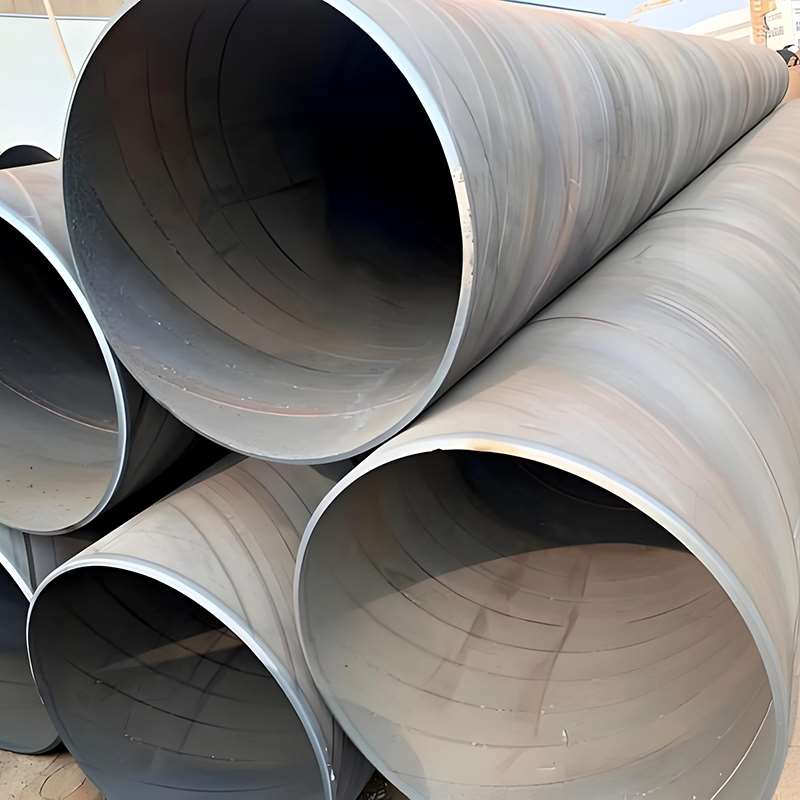
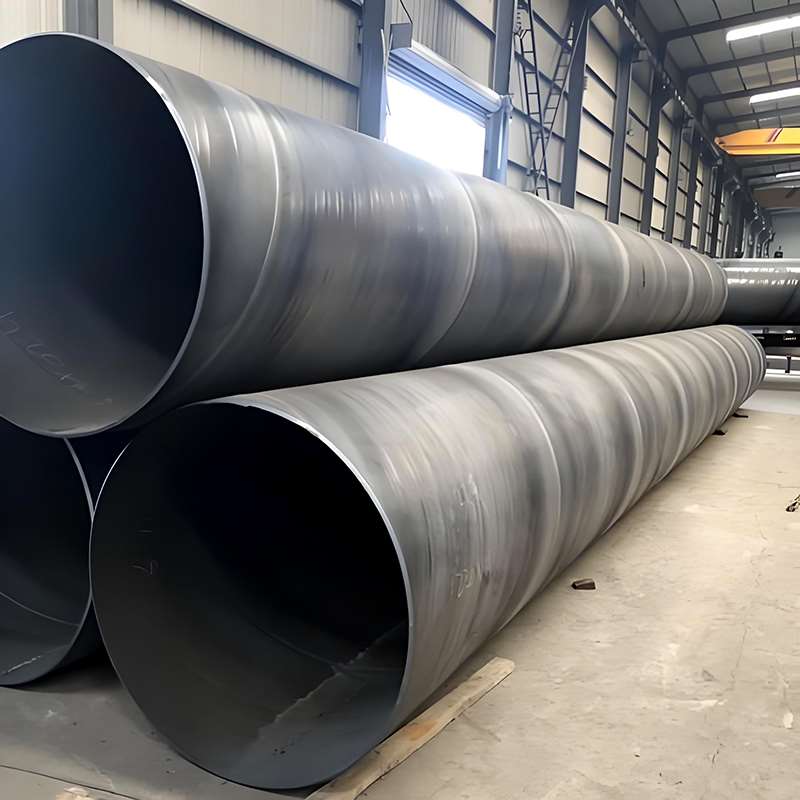
Spiral welded steel pipe is manufactured by forming steel strip into a tubular shape and then welding it longitudinally in a spiral seam. Compared with other types of steel pipes, it allows large-diameter pipe production using relatively narrow steel coils. As a result, it is widely used in water transmission, oil and gas pipelines, pile foundation engineering, and other infrastructure applications.
However, in real procurement practice, buyers often face a key challenge:
What diameter should be selected? What wall thickness is appropriate? And what are the differences between steel grades and anti-corrosion systems?
An improper selection not only compromises engineering safety but can also lead to unnecessary procurement costs. So how should spiral welded steel pipe specifications be correctly selected based on project requirements?
I. How to Select Diameter?
The diameter of a steel pipe determines its conveying capacity. In typical water intake and wastewater systems, diameter selection is mainly based on two principles:
1. Flow velocity must be controlled within a reasonable range
If the pipe diameter is too small, the water must flow faster to maintain the required throughput. This leads to two major issues:
- First, excessive internal friction increases energy consumption of pumps during operation.
- Second, high-velocity flow creates water hammer effects. Sudden valve closure may cause impact pressure on the pipe wall, increasing the risk of cracking or failure.
Conversely, if the diameter is too large, flow velocity becomes too low. While this reduces pumping energy, it significantly increases material costs for pipes and excavation works.
2. Industry-standard experience values
In engineering practice, flow velocity is generally controlled according to the following ranges:
- Gravity-fed (non-pressurized) systems: 0.6–1.2 m/s
- Pump-pressurized water systems: 1.0–2.0 m/s
- Natural gas pipelines: 4–15 m/s
Procurement tip:
If you provide the daily throughput requirement (tons per day), engineers can quickly calculate the required pipe diameter based on these velocity ranges and directly select standard pipe sizes according to national specifications.
II. How to Select Wall Thickness?
Wall thickness is the structural “skeleton” of a pipe. Insufficient thickness can lead to serious failures.
1. Internal pressure resistance (burst protection)
The pipe carries water or gas under pressure. The higher the internal pressure, the thicker the wall must be.
Material grade also plays a critical role. For example:
- High-grade steel such as API 5L X60 offers superior mechanical strength, allowing for thinner wall designs under the same pressure conditions.
- Ordinary steel such as Q235B has lower strength and therefore requires greater wall thickness to achieve equivalent safety performance.
2. External pressure resistance (collapse prevention)
Once buried underground, the pipe is subjected to soil load and traffic load from heavy vehicles. If a large-diameter pipe has a very thin wall, it may collapse or ovalize when internal pressure is removed during maintenance. This can damage the anti-corrosion coating and significantly shorten service life.
Therefore, pipes installed at greater burial depths or beneath roads must be designed with increased wall thickness.
III. Critical Manufacturing Limitation: Pipes Cannot Be “Too Thin”
In procurement, some buyers attempt to reduce cost by requesting larger diameter with reduced wall thickness. However, this is not always technically feasible.
Spiral welded pipe production is subject to forming constraints because it is manufactured from continuously coiled steel strip. There is a strict relationship between diameter and thickness.
1. Large-diameter pipes cannot be too thin
Industry practice generally requires that the diameter-to-thickness ratio (D/t) should not exceed 130.
For example:
- A pipe with a diameter of 1.4 m must have a minimum wall thickness of approximately 11 mm.
- If a thinner thickness such as 8 mm is forced, the steel strip will wrinkle or form wave-like edges during spiral forming. The finished pipe may also become oval-shaped during transportation, making field welding and alignment extremely difficult.
2. Small-diameter pipes cannot be too thick
For pipes below approximately 630 mm diameter, wall thickness is typically limited to ≤16 mm.
If the wall becomes too thick, the steel becomes too rigid for spiral forming equipment to process. In such cases, it is more appropriate to use straight seam welded pipes (LSAW/ERW) or seamless steel pipes, depending on design requirements.
IV. Five-Step Procurement Selection Method
To simplify decision-making, the selection process can be summarized as follows:
Step 1: Determine diameter requirement
- Question: “How many tons of water must be transported per day?”
- Purpose: Calculate the approximate outer diameter requirement.
Step 2: Verify internal pressure
- Question: “What is the maximum operating pressure (bar or MPa)?”
- Purpose: Determine the minimum wall thickness required for burst resistance.
Step 3: Evaluate external loads
- Question: “How deep is the burial? Will heavy trucks pass overhead?”
- Purpose: Define additional thickness needed for anti-collapse strength.
Step 4: Add safety allowance
- Question: “What is the service life requirement? Is the medium corrosive?”
- Purpose: Add 1–2 mm corrosion and wear allowance to finalize wall thickness.
Step 5: Optimize total cost
- Question: “Is it more cost-effective to use higher-grade steel with thinner wall or lower-grade steel with thicker wall?”
- Purpose: Select the most economical solution considering material cost, transportation efficiency, and weldability.
V. Engineering Selection Recommendations
In essence, selecting diameter and wall thickness is a balance between safety performance and project cost optimization.
Many experienced buyers tend to over-design conservatively to avoid risk, often choosing thicker specifications than necessary. However, modern large-scale engineering projects increasingly rely on computational stress analysis and simulation tools.
By inputting parameters such as pipe specification, burial depth, and traffic load into engineering software, it is possible to simulate real operating conditions. In many cases, this scientific approach ensures a 50-year service life while reducing steel consumption by 10%–15%.
For large procurement volumes, this translates into significant and direct cost savings—often representing substantial profit optimization for the project.