
Carbon steel pipes and black steel pipes are both commonly used types of steel pipes, especially in industrial, construction, and civil piping applications.
However, many people easily confuse them. This article will explain in detail their definitions, performance differences, application distinctions, and material selection recommendations to help you accurately identify and choose the right type.
I. Basic Definitions
i. Carbon Steel Pipe
Definition: A steel pipe made from carbon steel through hot rolling, cold drawing, or welding.
Characteristics: The carbon content affects strength and toughness; performance can be adjusted according to standards and heat treatment.
Types: Seamless carbon steel pipe, welded carbon steel pipe (ERW, SAW)
ii. Black Steel Pipe
Definition: A carbon steel pipe whose surface has not been galvanized or coated, named for its black oxide scale.
Characteristics: Poor corrosion resistance; suitable for transporting non-corrosive fluids, such as water, gas, and steam in low-pressure pipelines.
Types: Mostly welded pipe (ERW), a small number of seamless pipes.
II. Main differences between carbon steel pipes and black steel pipes
| Comparison Item | Carbon Steel Pipe | Black Steel Pipe |
|---|---|---|
| Material | Carbon steel, including low, medium, high carbon steel and alloy carbon steel | Carbon steel, typically low- or medium-carbon steel |
| Surface Treatment | Can be galvanized, painted, epoxy coated, or polished | No surface treatment, with a black oxide scale finish |
| Corrosion Resistance | Can be enhanced through surface treatment | Low corrosion resistance, prone to rust |
| Pressure Rating | Suitable for low- to high-pressure piping systems | Mainly used for low-pressure applications |
| Applications | Oil, gas, chemical, boiler, and high-pressure pipelines | Domestic water supply, HVAC systems, and gas pipelines |
| Price | Relatively higher, depending on surface treatment and material grade | Lower, due to simpler production and lower manufacturing cost |
-3.jpg)
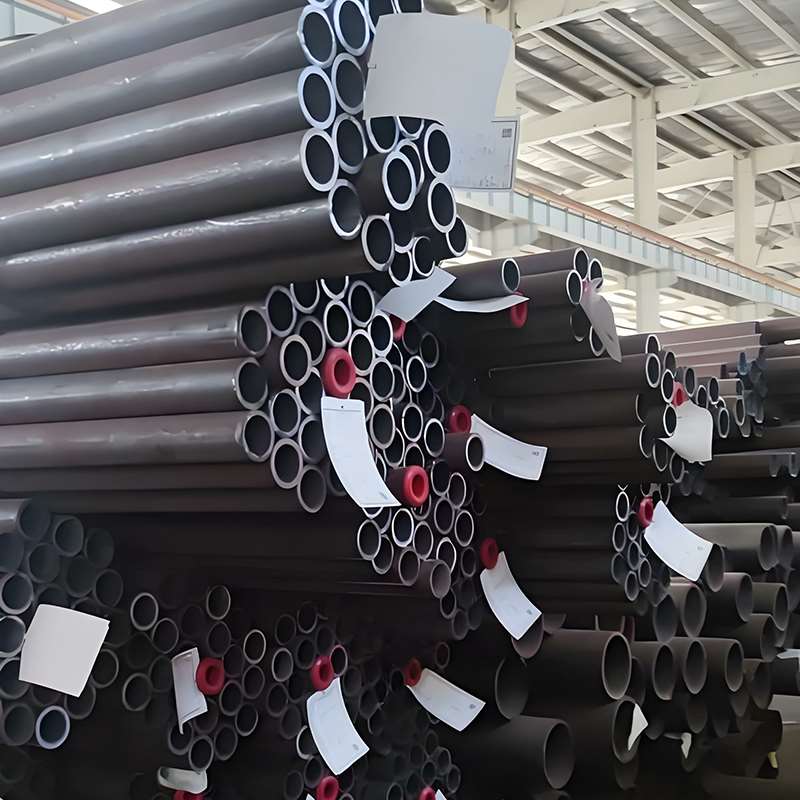
III. Differences in Applications
- Carbon steel pipes have a wide range of applications:
High-pressure pipelines: oil and natural gas transmission pipes
Industrial equipment: boiler tubes, high-temperature steam pipes
Building structures: steel structures, bridges - Black steel pipes are mostly used in low-pressure applications:
Household water supply pipelines
HVAC systems
Low-pressure gas transmission
IV. Material Selection Recommendations for Carbon Steel Pipes and Black Steel Pipes
i. Projects Suitable for Using Carbon Steel Pipes
- High-Pressure or High-Temperature Projects
Typical Projects: Oil and natural gas pipelines, boiler pipelines, steam pipelines
Reason: Carbon steel pipes have high strength and pressure resistance, capable of withstanding high-temperature and high-pressure fluid transportation, ensuring safety. - Corrosive or Special Media Environments
Typical Projects: Chemical plant pipelines, seawater pipelines, acid and alkali liquid pipelines
Reason: Carbon steel pipes can undergo surface galvanizing, spraying, or alloying treatments to improve corrosion resistance and extend pipeline life. - Structural Load-Bearing Projects
Typical Projects: Steel structure buildings, bridges, mechanical equipment support pipelines
Reason: Carbon steel pipes have high strength and good toughness, making them suitable for use as load-bearing components. - Industrial Machinery and High-Requirement Parts
Typical Projects: Hydraulic cylinders, mechanical drive shafts, pressure vessels
Reason: Carbon steel pipes have good mechanical properties and high dimensional accuracy, meeting precision machining and high-strength requirements.
ii. Projects suitable for selecting black steel pipes
- Low-Pressure Water and Gas Pipelines
Typical Projects: Urban water supply pipes, residential building water supply pipes, low-pressure gas pipelines
Reasons: Black steel pipes are low in cost, have suitable pressure resistance for low-pressure transmission, and are used in environments with low corrosion resistance requirements, thus saving costs. - Heating, Ventilation, and Air Conditioning (HVAC) Systems
Typical Projects: Heating pipes, air conditioning refrigerant pipes
Reasons: Black steel pipes are easy to process and weld, suitable for fluid transmission in room temperature and low-pressure environments. - Temporary or Non-Critical Piping Projects
Typical Projects: Temporary water supply and drainage systems at construction sites
Reasons: Short service life, low requirements for corrosion resistance and pressure resistance, making black steel pipes economical and practical.
iii. Material Selection Summary and Comparison
| Project Type | Recommended Pipe | Reason |
|---|---|---|
| High-pressure and high-temperature pipelines | Carbon Steel Pipe | High strength, excellent pressure resistance, high-temperature resistance, and suitable for anti-corrosion treatment |
| Chemical, seawater, or corrosive environments | Carbon Steel Pipe | Can be galvanized or coated, providing strong corrosion resistance |
| Structural construction and load-bearing pipelines | Carbon Steel Pipe | High strength and good toughness, capable of bearing structural loads |
| Industrial machinery components and pressure vessels | Carbon Steel Pipe | Good mechanical properties and high dimensional accuracy |
| Domestic water supply and low-pressure gas pipelines | Black Steel Pipe | Low cost, easy to fabricate, suitable for low-pressure and non-corrosive environments |
| HVAC systems | Black Steel Pipe | Easy to weld, moderate pressure resistance, suitable for ambient temperature applications |
| Temporary pipelines or non-critical conveying systems | Black Steel Pipe | Short service life requirements, economical and practical |