
I. What special requirements do oil and gas pipelines place on steel pipes?
The difference between oil and gas pipelines and ordinary water transmission pipelines lies in the more complex operating environment, which places higher demands on steel pipes.
For example, a long-distance natural gas pipeline may need to:
- Operate continuously for more than 30 years;
- Withstand high internal pressure;
- Cross complex terrain such as mountains, rivers, deserts, and wetlands;
- Be exposed to corrosive soil or humid environments for extended periods;
- Meet strict non-destructive testing and weld quality requirements.
Therefore, steel pipes used in oil and gas pipelines typically need to possess the following properties:
- High yield strength and tensile strength;
- Good weldability;
- Excellent low-temperature toughness and fracture resistance;
- Stable dimensional accuracy;
- Good corrosion resistance;
- Long service life.
Modern spiral-welded steel pipes have continuously improved in terms of manufacturing processes, steel properties, and quality control, and are now capable of meeting the technical requirements of a large number of oil and gas transmission projects.
II. Why Are Spiral-Welded Steel Pipes Preferred for Large-Diameter Oil and Gas Pipelines?
1. More Even Stress Distribution Along the Weld, Suitable for High-Pressure Transportation
- During operation, the internal pressure in oil and gas pipelines generates significant circumferential stress on the pipe walls. Compared to straight-seam steel pipes, the welds in spiral-welded steel pipes are oriented at an angle of 50°–75°, meaning they do not fully align with the primary direction of stress, resulting in a more even distribution of stress along the weld.
- At the same time, spiral welds are not distributed continuously along the pipe’s axial direction; thus, when local defects occur, cracks are less likely to propagate rapidly along a straight line. Therefore, provided they comply with standards such as API 5L and undergo rigorous testing, spiral-welded steel pipes can meet the strength and safety requirements of oil and gas pipelines.
2. Easier to Manufacture Large-Diameter Steel Pipes
As transmission capacity continues to increase, oil and gas pipelines are increasingly adopting DN800, DN1000, and even larger diameters.
Spiral welded steel pipes are produced by continuously rolling hot-rolled steel strips; by simply adjusting the forming angle, pipes of different diameters can be manufactured without the need to switch between steel plates of different widths.
This process offers the following advantages:
- Suitable for producing large-diameter steel pipes;
- High raw material utilization;
- High production efficiency;
- Easier to meet the demands of large-scale projects.
3. Comprehensive Cost Advantages
- Long-distance oil and gas pipelines typically require large quantities of steel pipes, and procurement costs account for a significant portion of the total project investment.
- Spiral welded steel pipes are produced continuously, offering high manufacturing efficiency and typically providing a cost advantage for large-diameter products.
- In addition, their dimensional consistency allows for the use of the “Pipe-in-Pipe” (large pipe encasing a smaller pipe) transportation method, which improves loading efficiency and reduces shipping and land transportation costs.
4. Excellent Corrosion Resistance and Adaptability to Complex Environments
Most oil and gas pipelines are buried underground, making corrosion resistance critical.
Spiral-welded steel pipes can be equipped with a variety of proven corrosion protection methods, such as:
- FBE-Coated Steel Pipe
- Double-Layer FBE
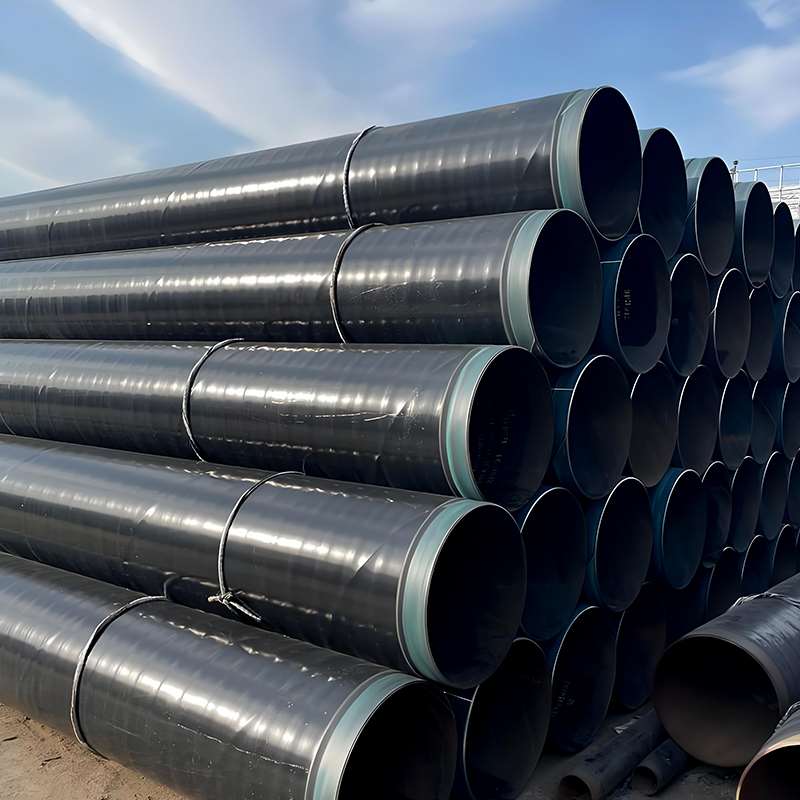
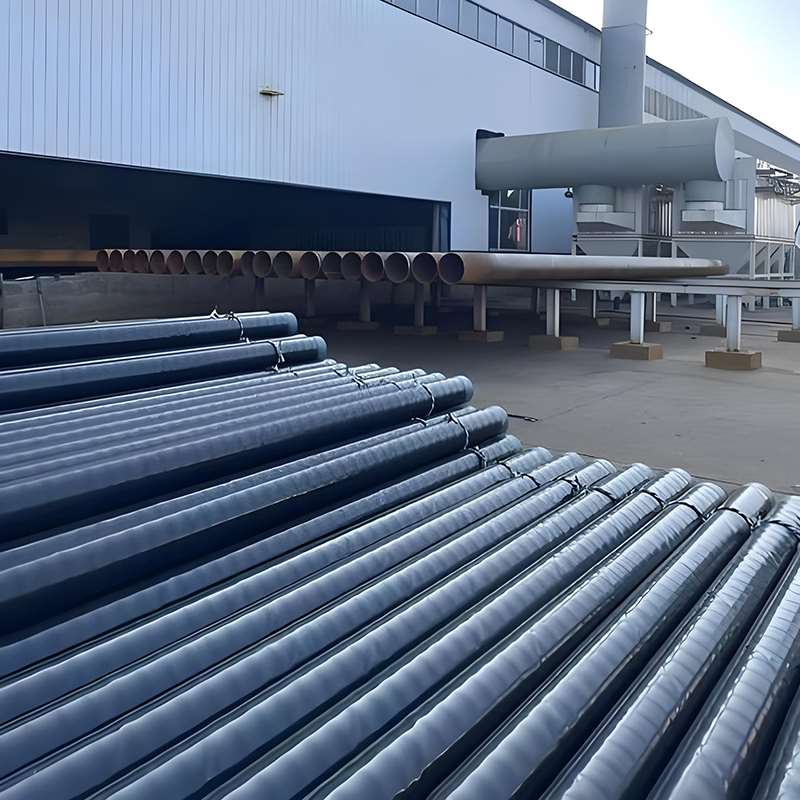
- 3PE Corrosion-Resistant Steel Pipe
- 3LPP Corrosion-Resistant Steel Pipe
These protective coatings effectively enhance the pipes’ corrosion resistance and extend their service life.
III. Does a spiral weld affect safety?
This is a question frequently raised by many procurement professionals and engineers.
In fact, whether a weld is safe does not depend on whether it is a spiral weld or a straight seam weld, but rather on the steel pipe’s design, manufacturing process, weld quality, and inspection standards.
- Modern spiral-welded steel pipes generally employ a double-sided submerged arc welding process, in which the weld is performed simultaneously on both the inner and outer surfaces, ensuring excellent weld quality and consistency.
- During production, the welds typically undergo multiple inspections, including ultrasonic testing (UT), radiographic testing (RT), and hydrostatic testing, to ensure there are no defects that could compromise safety.
- Furthermore, spiral-welded steel pipes used for oil and gas transportation are generally manufactured in accordance with standards such as API 5L, ISO 3183, and GB/T 9711, which impose strict requirements on steel properties, welding processes, non-destructive testing, and quality control.
- Therefore, as long as the product complies with relevant standards and passes the required quality inspections, the spiral weld will not pose a risk to the safety of oil and gas pipelines.
IV. Comprehensive Corrosion Protection System: Ensuring Pipeline Safety Throughout Its Lifecycle
Although steel pipes possess high mechanical strength, they are prone to corrosion and perforation in complex electrochemical environments—such as underground soils that are damp, saline-alkali, or acidic or alkaline—if not effectively protected. Therefore, long-distance oil and gas pipelines must be equipped with both internal and external corrosion protection systems to ensure a design service life of 30 to 50 years.
The industry’s leading corrosion protection solutions include:
- FBE (Fused-Bonded Epoxy) Coating for the Outer Wall
- Technical Features: Utilizes a thermosetting cross-linking process to create both physical and chemical bonding between the coating and the steel surface.
- Key Advantages: Strong adhesion, excellent resistance to cathodic disbonding, resistance to chemical corrosion, and high-temperature resistance. It is widely used in various buried environments and pipe jacking sections. In many oil and gas and water conservancy trunk lines, FBE-coated steel pipes serve as the primary or preferred corrosion protection solution.
- Three-Layer Polyethylene Coating
Currently the most widely used external corrosion protection system for long-distance buried oil and gas pipelines, it consists of a “three-in-one” composite structure:
- FBE base layer: Provides strong adhesion and resistance to cathodic disbonding;
- Adhesive intermediate layer: Ensures a strong bond between the epoxy powder and the polyethylene outer layer;
- Polyethylene (PE) outer layer: Provides mechanical protection against soil stress, puncture, and water vapor penetration.
- Application Evaluation: Combining corrosion protection with high resistance to mechanical impact, this is the preferred solution for long-distance pipelines in complex soil environments.
- Internal Friction-Reducing and Corrosion-Resistant Coatings
- For the inner walls of oil and natural gas pipelines, liquid epoxy internal coatings or fluid friction-reducing coatings are typically applied:
- Dual benefits: These coatings effectively isolate the pipe walls from corrosion caused by sulfides and water vapor in the transported medium, while also significantly reducing internal wall roughness. This minimizes head loss and pressure drop along the pipeline, thereby improving overall transmission efficiency and reducing energy consumption at pumping stations.