
I. Definition of Carbon Steel Pipe
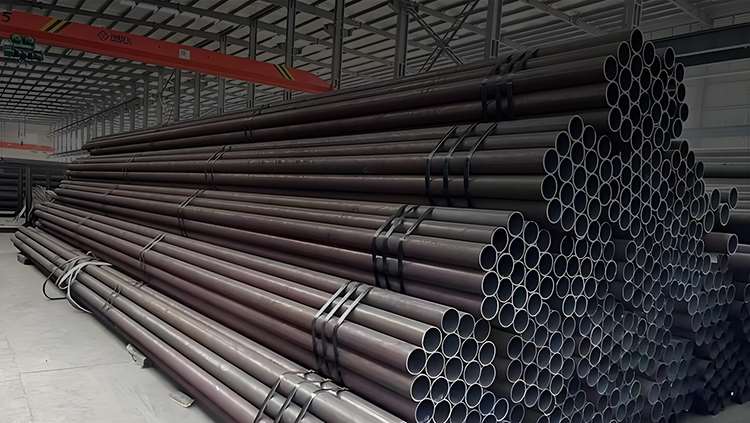
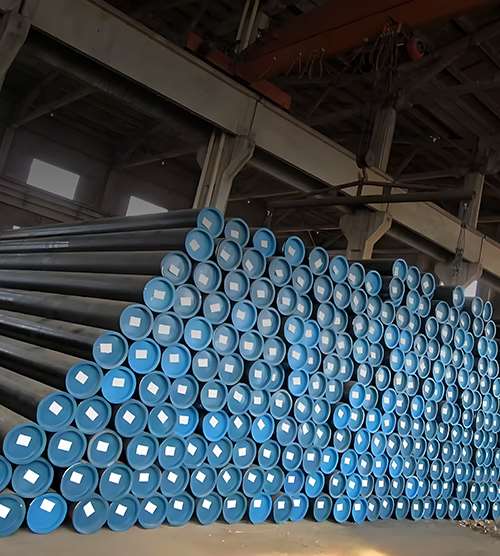
Carbon steel pipe is a steel pipe made from carbon steel through processes such as hot rolling, cold rolling, or welding.
A key characteristic of carbon steel pipe is that its carbon content directly affects its performance: higher carbon content results in higher hardness and strength, but lower toughness and weldability.
i. Material Composition of Carbon Steel Pipe
| Material Type | Carbon (C) | Manganese (Mn) | Silicon (Si) | Sulfur (S) | Phosphorus (P) |
|---|---|---|---|---|---|
| Low Carbon Steel | ≤ 0.25% | 0.30–0.90% | 0.10–0.35% | ≤ 0.05% | ≤ 0.05% |
| Medium Carbon Steel | 0.25–0.55% | 0.60–1.20% | 0.15–0.35% | ≤ 0.05% | ≤ 0.05% |
| High Carbon Steel | 0.55–1.00% | 0.60–1.00% | 0.15–0.35% | ≤ 0.05% | ≤ 0.05% |
ii. Manufacturing Process of Carbon Steel Pipes
Common manufacturing processes are mainly divided into two categories: seamless pipes and welded pipes.
1. Seamless Carbon Steel Pipe Manufacturing Process
(1) Hot-rolled Seamless Pipe
Process Flow: Steel Ingot → Heating → Piercing → Hot Rolling → Sizing → Annealing → Inspection
Features: Smooth inner wall, high strength, can withstand high temperature and high pressure
Applications: Oil, natural gas, high-pressure boiler pipelines
(2) Cold-drawn Seamless Pipe
Process Flow: Hot-rolled seamless pipe → Cold drawing and stretching → Sizing → Annealing → Finishing
Features: High dimensional accuracy, smooth surface, better mechanical properties
Applications: Machinery manufacturing, hydraulic equipment, precision piping
2. Manufacturing Process of Welded Carbon Steel Pipes
(1) ERW (Electrical Resistance Welded Pipe)
Process Flow: Steel strip → Forming → High-frequency resistance welding → Straightening → Inspection
Features: High production efficiency, low cost, widely used in conventional pressure pipelines
Applications: Water pipes, HVAC pipelines, structural pipes
(2) SAW (Submerged Arc Welded Pipe)
Process Flow: Steel plate → Forming → Internal and external welding → Straightening → Inspection
Features: Good weld quality, can produce large-diameter pipes
Applications: Oil and gas pipelines, large structural pipelines, water supply projects
3. Heat Treatment and Surface Treatment
(1) Heat Treatment
Annealing: Eliminates internal stress and improves toughness
Normalizing: Increases strength and hardness
Quenching and Tempering: Balances strength and toughness
(2) Surface Treatment
Zinc plating: Corrosion resistant, suitable for outdoor use or water pipes
Painting or epoxy coating: Corrosion and abrasion resistant
Polishing or lining: Suitable for the food, pharmaceutical, or drinking water industries
II. Main Uses of Carbon Steel Pipes
- Oil and Gas Pipelines
Used for transporting crude oil, natural gas, and related chemical media. Common pipe material: Seamless carbon steel pipe (for high-pressure and high-temperature environments) - Boilers and High-Pressure Vessels
Suitable for handling high-temperature and high-pressure fluids. Common pipe materials: Hot-rolled seamless pipe, alloy carbon steel pipe - Machinery Manufacturing
Used for structural components such as hydraulic cylinders, mechanical transmission shafts, and support rods. Characteristics: Requires high dimensional accuracy, a balance of strength and toughness. - Chemical Industry
Transporting corrosive or high-temperature chemical media. Requires selection of high-corrosion-resistant carbon steel pipes or surface-treated pipes depending on the media.
ii. Construction field
- Building Structures
Steel frame structures, bridges, scaffolding
Features: High strength, high load-bearing capacity - Water Supply and Drainage Pipelines
Used in urban water supply and drainage systems, fire protection pipelines
Commonly uses welded carbon steel pipes, galvanized for corrosion protection when necessary.
iii. Civil and Domestic Applications
- Heating, Ventilation, and Air Conditioning (HVAC) Systems
Transporting hot water, steam, and refrigerants
Features: Requires pressure resistance and high temperature resistance - Agriculture and Irrigation
Low-pressure water pipes, drainage pipes
Features: Corrosion resistant, clog-resistant - Decorative and Furniture Structures
Interior decorative pipes, furniture supports
Features: Aesthetically pleasing surface treatment, easy to process.
III. Precautions for selecting carbon steel pipes
- Pipe Specifications
Outer Diameter: Selected based on the flow rate of the transported medium.
Wall Thickness: Determines pressure resistance.
Length: Selected according to installation requirements (standard length or custom length). - Strength and Grade
Different grades according to standards such as ASTM, GB, and EN affect mechanical properties and service life. - Operating Environment
Corrosion resistance?
High temperature or high pressure resistance? - Surface Treatment
Zinc plating or anti-corrosion treatment to extend service life. Polished inner wall or anti-scaling treatment, suitable for the food and drinking water industries.
IV. Common Standards for Carbon Steel Pipes
ASTM A106: Seamless carbon steel tubing for high-temperature fluid transport
ASTM A53: Welded and seamless carbon steel tubing, suitable for general applications
GB/T 8163: Chinese standard for fluid transport pipes
EN 10210 / EN 10216: European standards covering structural and pressure applications