
I. Three Process Differences Between SSAW and ERW
1. Differences in Welding Processes and Forming Methods
ERW: This process utilizes the “skin effect” of high-frequency current to instantly heat the edges of butt-joined steel plates to a molten state, after which they are mechanically pressed together by rollers. The entire process requires no filler rods or wires; it is a self-fusion welding process using the base material itself, resulting in a very thin weld seam with a nearly flat surface.
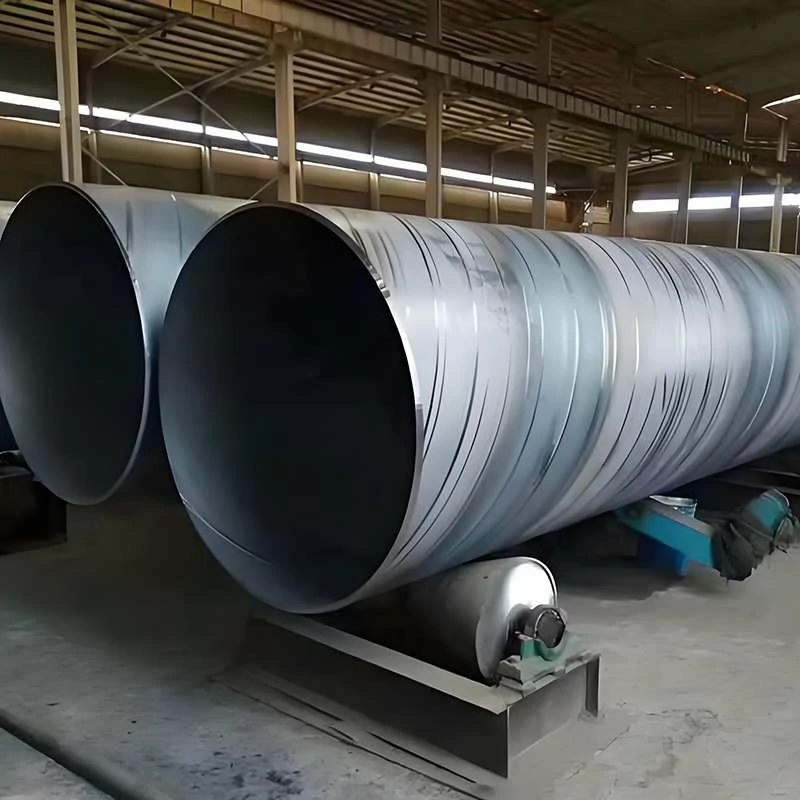
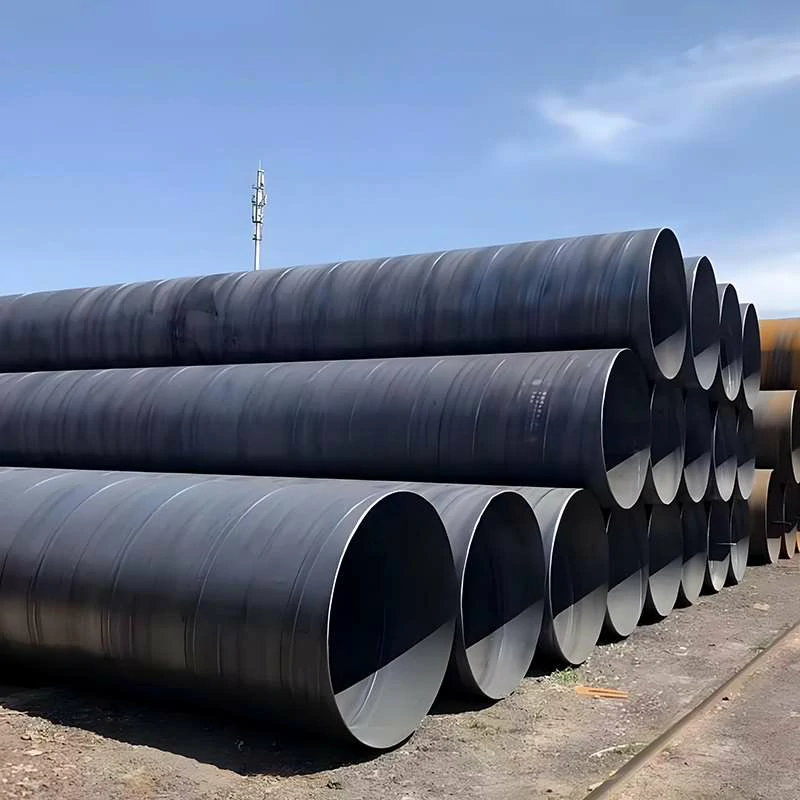
SSAW: Hot-rolled steel strip is coiled into a circular tube at a specific helix angle, and then welded using welding wire and flux via a double-sided submerged arc automatic welding process. The weld forms a “spiral line” encircling the tube, with distinct inner and outer weld beads (raised weld ridges).
2. Production Limits for Pipe Sizes and Diameters
Limitations of ERW: Due to constraints imposed by the longitudinal seam forming line and high-frequency welding power, ERW steel pipes are typically limited to medium- and large-diameter as well as small- and medium-diameter sizes (usually with an outer diameter of 610 mm / 24 inches or less), and wall thicknesses generally do not exceed 20 mm.
Advantages of SSAW: The advantage of spiral-welded pipes is that they can produce a wide range of extra-large diameters using steel strips of a fixed width. Their production range typically spans from 219 mm up to 3,000 mm or more. If you need a pipe with a diameter of 1 meter or 2 meters or more, ERW is simply incapable of meeting this requirement, so SSAW must be chosen.
3. Weld Length and Stress Conditions
ERW: The weld is a straight seam, and its length is exactly equal to the length of the steel pipe (for example, a 12-meter pipe has a 12-meter weld).
SSAW: Because the weld is spiral-shaped, its length is typically 1.5 to 2 times that of the pipe. Many people worry that a longer weld is more prone to cracking, but in terms of stress mechanics, when a pipe is subjected to internal pressure, the maximum stress occurs in the circumferential direction. The stress borne by a spiral weld is significantly less than that of a straight weld, so spiral-welded pipes perform better in terms of burst resistance and tear resistance.
II. Who Should You Choose for Your Project?
To help you make the right decision quickly when designing a project or signing a procurement contract, you can refer to the following user decision matrix:
| Key Consideration Factor | ERW Longitudinal Electric Resistance Welded Pipe | SSAW Spiral Submerged Arc Welded Pipe | Golden Selection Recommendations for Field Applications |
|---|---|---|---|
| Pipe Diameter Requirement (OD) | Suitable for ≤ 610 mm (24″) | Suitable for large diameters ≥219 mm – 3000 mm+ | Choose SSAW for large diameters: For pipe diameters exceeding 610 mm, spiral welded pipe is the preferred choice in most cases. |
| Appearance and Geometric Accuracy | Excellent (uniform wall thickness and superior roundness) | Good (but with residual welding stress and ovality tolerances) | Choose ERW for high-precision fittings: If the pipeline requires frequent connections with high-precision valves and flanges, ERW provides faster alignment and installation, especially for small and medium diameters. |
| Geometric Rigidity and Piling Applications | Good axial bending resistance | Excellent radial compression resistance and high structural rigidity | Choose SSAW for foundation piling: The spiral weld structure wraps around the pipe like a spring, providing strong resistance to soil pressure and high bearing capacity when used as pile pipe. |
| Project Budget (Price) | Moderate (high cost-performance ratio for small and medium diameters) | Highly competitive (especially for large diameters with better material efficiency) | Choose SSAW for large-diameter budget control: In large-diameter and long-distance water transmission projects, SSAW can significantly reduce material costs. |
III. A Head-to-Head Comparison of Application Scenarios: Where Are They Used?
ERW Application Scenarios:
- Urban Low- and Medium-Pressure Gas/Water Distribution Networks: Within cities, pipe diameters are typically less than 500 mm. These applications demand high standards for pipe roundness, inner wall smoothness, and the absence of misalignment, making ERW the primary choice.
- Transportation of refined petroleum products: For branch or terminal oil pipelines with moderate diameters, the goal is to achieve zero weld bead height to minimize fluid resistance.
- Mechanical structures and scaffolding: These applications leverage the pipes’ dimensional accuracy and uniform wall thickness.
Applications of SSAW Carbon Steel Pipe:
- Long-distance natural gas/crude oil trunk lines: For transnational or interprovincial trunk lines—often spanning thousands of kilometers with diameters around 1 meter—SSAW is the preferred choice due to its exceptional cost-effectiveness and ability to manufacture large-diameter pipes.
- Bridge, Dock, and Building Piling Projects: The physical structure of spiral-welded steel pipes provides radial stiffness, making them resistant to deformation when struck by a pile driver, a feature highly favored by chief engineers in foundation engineering.
- River Dredging and Sediment Removal: Used for removing sediment during port excavation, these pipes feature large diameters, high wear resistance, and the ability to easily adapt to various complex field conditions.