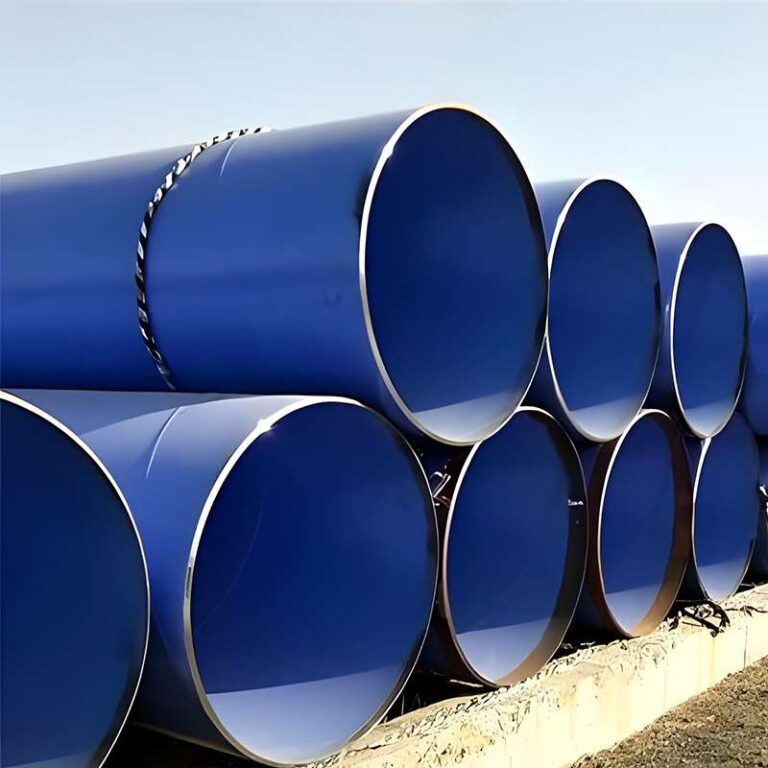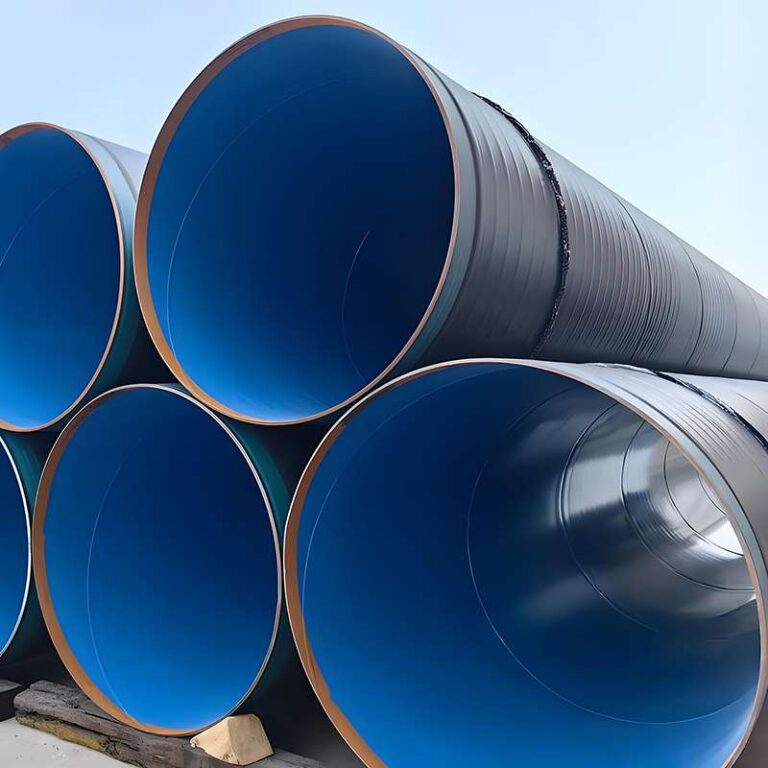
I. Why Are More and More Projects Choosing 3PE Coated Spiral Steel Pipes?
In oil, natural gas, municipal water supply, wastewater treatment, and industrial pipeline projects, steel pipes are often buried underground for long-term service or exposed to complex environmental conditions.
When selecting steel pipes, many buyers are not simply focusing on the “price of the steel pipe”. Instead, they are looking for a more important answer:
How can pipelines maintain safe and stable operation for decades, while avoiding leakage, repairs, or even replacement caused by corrosion?
Although ordinary spiral steel pipes have excellent pressure-bearing capacity and structural strength, the steel itself is vulnerable to external environmental factors:
- Moisture in the soil can cause electrochemical corrosion;
- Salts, acids, and alkaline substances can accelerate steel corrosion;
- Corrosion is more severe in coastal areas, high-humidity environments, and high-salt regions;
- Once corrosion occurs in long-distance underground pipelines, repair costs can be extremely high.
Therefore, in large-scale pipeline projects, the combination of spiral steel pipe + high-performance anti-corrosion coating has become a common solution. Among various anti-corrosion technologies, 3PE coating technology is widely used in underground transmission pipelines due to its excellent overall performance.
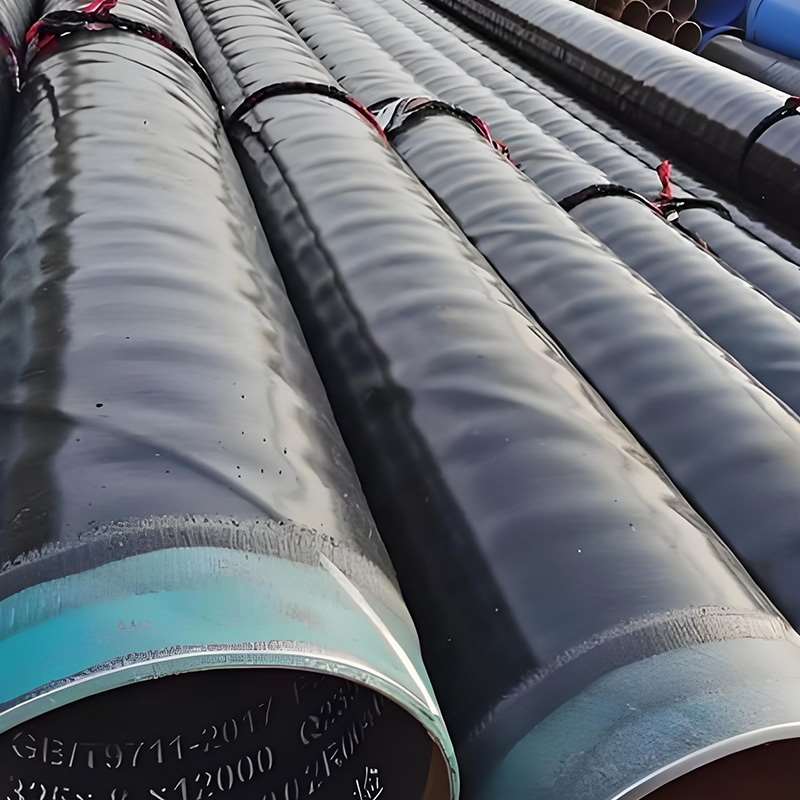
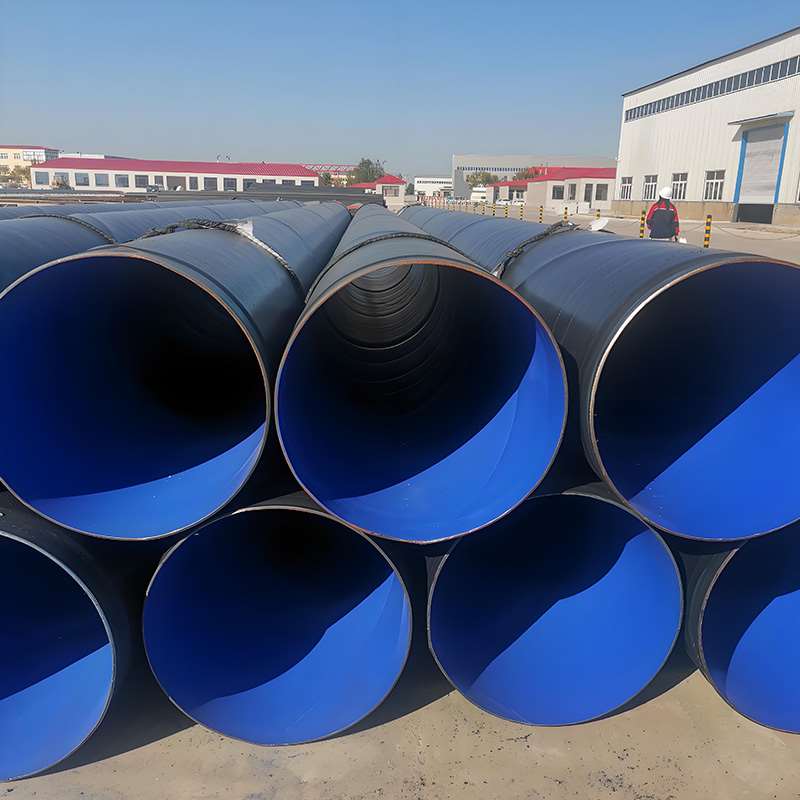
II. Specifications, Dimensions, and Weight Table of 3PE Anti-corrosion Spiral Steel Pipe
| Outside Diameter (mm) | Wall Thickness (mm) | Theoretical Weight (kg/m) | Weight per 12 m Pipe (kg/pc) |
|---|---|---|---|
| 219 | 6 | 31.5 | 378 |
| 219 | 8 | 41.6 | 499 |
| 273 | 6 | 39.9 | 479 |
| 273 | 8 | 52.3 | 628 |
| 325 | 6 | 47.7 | 572 |
| 325 | 8 | 62.5 | 750 |
| 325 | 10 | 77.7 | 932 |
| 377 | 6 | 55.5 | 666 |
| 377 | 8 | 72.4 | 869 |
| 377 | 10 | 88.8 | 1066 |
| 426 | 6 | 62.3 | 748 |
| 426 | 8 | 81.7 | 980 |
| 426 | 10 | 101.0 | 1212 |
| 478 | 6 | 70.1 | 841 |
| 478 | 8 | 92.2 | 1106 |
| 478 | 10 | 113.8 | 1366 |
| 529 | 6 | 77.7 | 932 |
| 529 | 8 | 102.3 | 1228 |
| 529 | 10 | 126.5 | 1518 |
| 630 | 6 | 92.7 | 1112 |
| 630 | 8 | 122.0 | 1464 |
| 630 | 10 | 150.4 | 1805 |
| 630 | 12 | 177.7 | 2132 |
| 720 | 8 | 140.0 | 1680 |
| 720 | 10 | 172.7 | 2072 |
| 720 | 12 | 204.8 | 2458 |
| 820 | 8 | 159.8 | 1918 |
| 820 | 10 | 197.0 | 2364 |
| 820 | 12 | 233.9 | 2807 |
| 920 | 8 | 179.5 | 2154 |
| 920 | 10 | 221.2 | 2654 |
| 920 | 12 | 262.5 | 3150 |
| 1020 | 8 | 199.2 | 2390 |
| 1020 | 10 | 245.5 | 2946 |
| 1020 | 12 | 291.4 | 3497 |
| 1020 | 14 | 337.2 | 4046 |
| 1220 | 10 | 294.0 | 3528 |
| 1220 | 12 | 349.0 | 4188 |
| 1220 | 14 | 404.0 | 4848 |
| 1220 | 16 | 458.7 | 5504 |
| 1420 | 10 | 342.5 | 4110 |
| 1420 | 12 | 407.0 | 4884 |
| 1420 | 14 | 471.0 | 5652 |
| 1420 | 16 | 535.0 | 6420 |
| 1620 | 12 | 465.0 | 5580 |
| 1620 | 14 | 538.0 | 6456 |
| 1620 | 16 | 610.0 | 7320 |
| 1620 | 18 | 682.0 | 8184 |
| 1820 | 14 | 605.0 | 7260 |
| 1820 | 16 | 680.0 | 8160 |
| 1820 | 18 | 754.0 | 9048 |
| 2020 | 16 | 756.0 | 9072 |
| 2020 | 18 | 847.0 | 10164 |
| 2020 | 20 | 936.0 | 11232 |
| 2220 | 18 | 931.0 | 11172 |
| 2220 | 20 | 1036.0 | 12432 |
| 2220 | 22 | 1140.0 | 13680 |
| 2420 | 20 | 1132.0 | 13584 |
| 2420 | 22 | 1242.0 | 14904 |
| 2420 | 25 | 1409.0 | 16908 |
| 2620 | 22 | 1345.0 | 16140 |
| 2620 | 25 | 1525.0 | 18300 |
| 2820 | 25 | 1643.0 | 19716 |
| 3020 | 25 | 1760.0 | 21120 |
| 3220 | 25 | 1878.0 | 22536 |
| 3500 | 25 | 2045.0 | 24540 |
III. Standards and Steel Grades for 3PE Coated Spiral Steel Pipes
Standards:
| Standard Category | Applicable Standard |
|---|---|
| Spiral Steel Pipe Manufacturing Standards | API 5L, ISO 3183, GB/T 9711, EN 10217 |
| Anti-Corrosion Coating Standards | ISO 21809-1, DIN 30670, SY/T 0413 |
| Surface Preparation Standards | ISO 8501-1 (Sa2.5 abrasive blasting for rust removal) |
| Inspection Standards | API 5L, ISO 3183, EN 10204 3.1 |
Material and steel grade:
| Standard | Common Materials / Steel Grades |
|---|---|
| API 5L | Grade B, X42, X52, X60, X65 |
| ISO 3183 | L245, L290, L360, L415 |
| GB/T 9711 | L245, L290, L360, L415 |
| ASTM A252 | Grade 2, Grade 3 |
| Chinese Carbon Steel Grades | Q235B, Q355B |
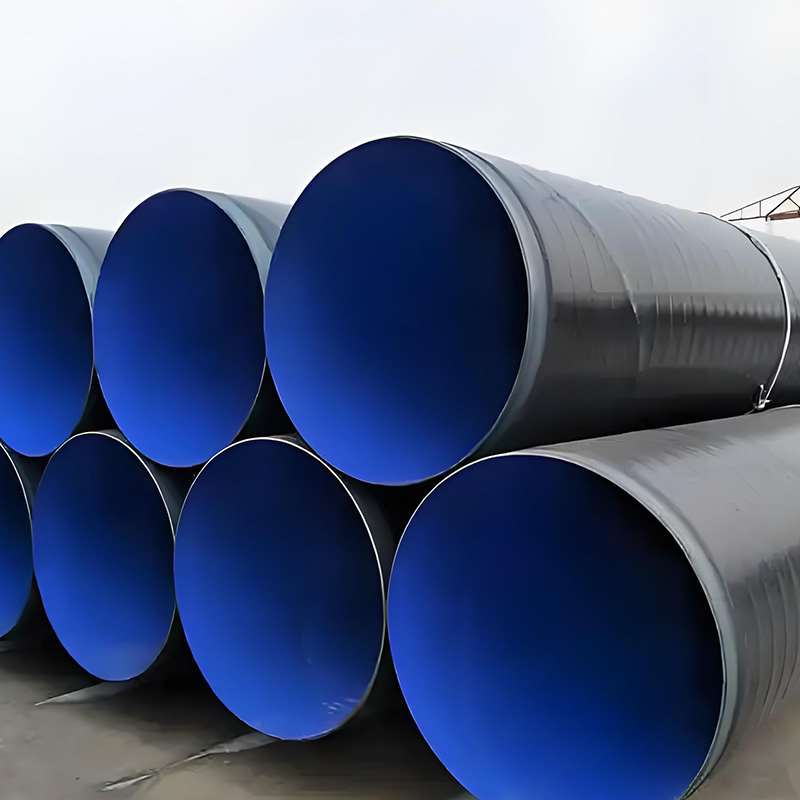
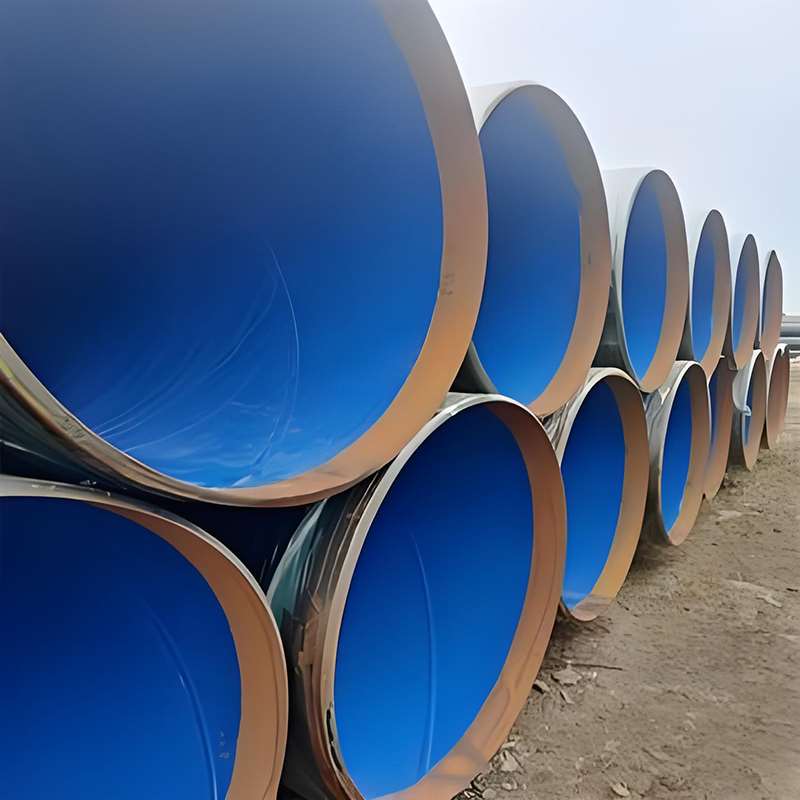
IV. Anti-corrosion level and coating structure
3PE anti-corrosion steel pipe anti-corrosion grade
| Anti-Corrosion Grade | Coating Structure | Total Coating Thickness | Applicable Environment |
|---|---|---|---|
| Normal Grade (N) | FBE epoxy powder + adhesive + PE polyethylene | ≥ 2.5 mm | General soil environments and ordinary underground water transmission pipelines |
| Enhanced Grade (W) | FBE epoxy powder + adhesive + PE polyethylene | ≥ 3.0 mm | Wet soil, saline-alkali areas, and environments with relatively high corrosion risks |
| Super Enhanced Grade (S) | FBE epoxy powder + adhesive + PE polyethylene | ≥ 3.7 mm | High-salt, high-humidity, highly corrosive areas and complex underground environments |
3PE anti-corrosion coating composition parameters
| Coating Layer | Material | Main Function |
|---|---|---|
| First Layer | Epoxy Powder (FBE) ≥ 80 μm | Provides anti-corrosion protection for the steel pipe surface and ensures high adhesion strength |
| Second Layer | Adhesive Layer (AD) approx. 170–250 μm | Enhances the bonding strength between the FBE layer and the PE layer |
| Third Layer | Polyethylene (PE) 1.8–3.7 mm | Provides mechanical protection and resistance against environmental corrosion |
V. Selection Guide: How to Match the Right Specifications According to Operating Conditions?
1. Matching Base Pipe Standards and Materials
The base pipe serves as the structural foundation for pipeline pressure resistance and mechanical strength. It should be selected according to the conveyed medium and pressure rating:
Conventional Municipal Water Supply and Structural Engineering:
It is recommended to use SY/T 5037 or ASTM A252 standards, which provide high cost-effectiveness while meeting required pressure-bearing requirements.
High-Pressure Oil & Gas Transmission and Long-Distance Cross-Regional Water Transfer:
It is recommended to specify GB/T 9711 or API 5L (PSL1/PSL2) standards to ensure higher weld toughness and resistance to cracking.
2. Anti-Corrosion Coating Grade (Standard Grade vs. Enhanced Grade)
The selection of the 3PE anti-corrosion coating mainly depends on the pipeline installation environment and construction method:
Standard Grade (N Grade):
The coating thickness is typically 2.5–3.0 mm, suitable for conventional open-cut excavation and backfill projects with low groundwater levels and uniform soil conditions.
Enhanced Grade (S Grade):
The coating thickness is increased to 3.0–3.7 mm. For sections constructed using horizontal directional drilling (HDD), as well as high-salt alkaline soil, swamp areas, and geological environments with a large amount of gravel, the enhanced grade must be selected to withstand strong pulling forces and severe mechanical abrasion.
3. Key Points and Supporting Component Selection
Pipe End Allowance and Protection:
For on-site welding projects, the pipe ends should be uniformly beveled (30°–35°). It should also be clearly specified that the carbon steel pipe manufacturer reserves a 100–150 mm bare steel section at both pipe ends to prevent the anti-corrosion coating from being damaged by high welding temperatures during field installation.
Synchronized Selection of Anti-Corrosion Joint Coating:
Weld joint coating is the weakest point in the corrosion protection system of the entire pipeline network. During procurement, it is essential to select 3PE radiation cross-linked heat-shrinkable sleeves (or tapes) with the same anti-corrosion grade as the main pipe coating, ensuring consistent corrosion protection performance throughout the entire pipeline system.