
In long-distance water and oil transmission projects, pipelines must not only withstand internal pressure from high-pressure fluids but also resist long-term corrosion from underground soil, moisture, and chemical agents. Selecting pipe materials that offer both high strength and long-lasting corrosion resistance is critical to ensuring the safety and managing the lifecycle costs of the entire infrastructure project.
FBE epoxy powder-coated spiral welded steel pipes, thanks to their chemical stability, excellent adhesion, and the structural pressure-bearing advantages of spiral welded pipes, have become the material of choice for interregional water diversion projects, urban water supply trunk lines, and crude oil/refined oil transmission pipelines.
I. What Is FBE Corrosion Protection Technology?
FBE is a polymer-based corrosion-resistant coating formed through a thermosetting process. The production process involves electrostatic spraying of specially formulated epoxy powder onto the surface of steel pipes preheated to 180°C to 230°C. Under the influence of heat, the powder rapidly melts, flows, and undergoes a cross-linking reaction; once cured, it bonds tightly with the steel pipe to form a single, integrated unit.
When this coating technology is applied to spiral-seam submerged-arc-welded steel pipes, the result is the FBE-coated steel pipe, which is frequently used in engineering projects.
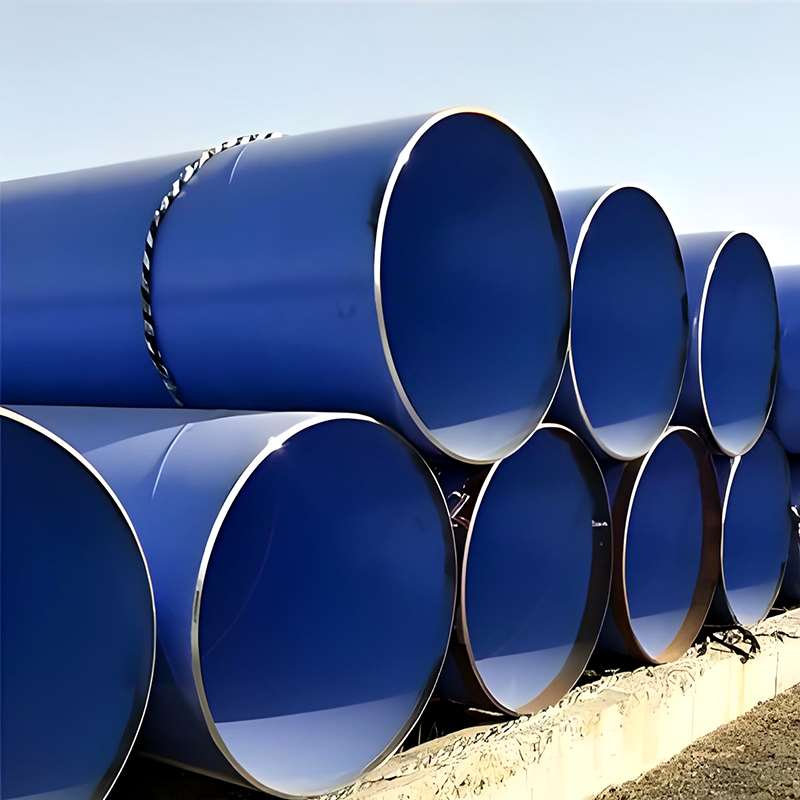
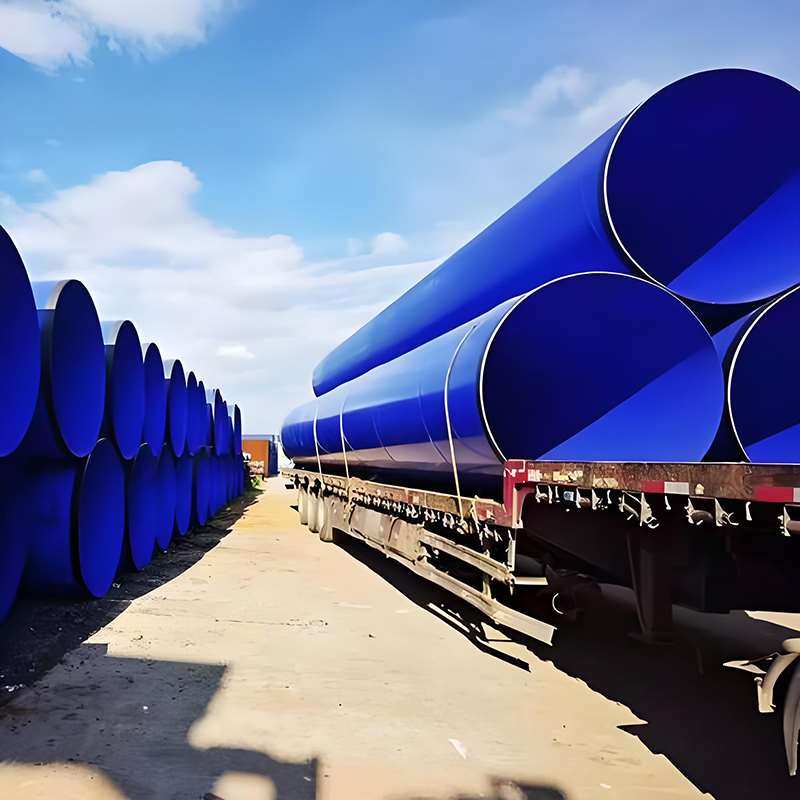
II. Why Are FBE-Coated Spiral-Welded Steel Pipes Suitable for Water and Oil Transportation?
Water and oil transmission pipelines are buried underground for many years and face multiple challenges, including soil electrochemical corrosion, microbial erosion, and fluctuations in the temperature of the transported media. The use of FBE-coated spiral-welded steel pipes offers the following advantages:
1. Excellent Adhesion and Resistance to Cathodic Delamination
The FBE coating penetrates the microscopic anchor patterns on the steel pipe’s surface while in a molten state, forming extremely strong intermolecular bonds. In actual engineering applications, pipelines are typically used in conjunction with an impressed-current cathodic protection system. FBE-coated steel pipes exhibit strong resistance to cathodic delamination; even if the coating sustains localized mechanical scratches, the corrosive medium finds it difficult to propagate along the interface, thereby ensuring the long-term safety of the pipe body.
2. Resistance to Chemical Corrosion from Oils and Suitability for High-Temperature Operating Environments
In oil transmission projects, crude oil and refined petroleum products contain sulfides, acidic substances, and various organic solvents, and are often heated to reduce viscosity for transportation. FBE coatings are resistant to chemical media and maintain structural integrity within a temperature range of -30°C to 100°C; they do not soften or dissolve when immersed in oil.
3. Drinking Water Safety and Hydraulic Conveyance Efficiency
When used in water transmission pipelines (particularly for internal anti-corrosion protection), the use of drinking-water-grade epoxy powder ensures that the coating is non-toxic, odorless, and free of heavy metal leaching. At the same time, the surface of the cured FBE coating is extremely smooth, reducing frictional resistance on the inner wall of the pipeline. This increases water flow under the same pumping pressure and reduces long-term operational energy consumption.
4. Pressure-Resistance and Large-Diameter Advantages of Spiral-Welded Steel Pipes
Spiral-welded submerged-arc-welded steel pipes offer excellent radial compressive strength and the capability to manufacture large diameters. Applying an FBE coating to spiral-welded steel pipes not only preserves the pipe’s inherent physical properties—such as high pressure resistance and resistance to deformation caused by geological subsidence—but also addresses the metal’s susceptibility to corrosion.
III. Comparison of Application Scenarios for Single-Layer FBE and Double-Layer FBE
| Coating Type | Structural Features | Performance Advantages | Typical Applications |
|---|---|---|---|
| Single-layer FBE | Coating thickness typically 300–500 μm | High adhesion, excellent flexibility, and cost-effective | Buried water transmission pipelines in normal soil conditions; internal corrosion protection for drinking water pipelines |
| Dual-layer FBE (Dual-layer FBE / DPS) | Standard FBE primer with a high-toughness, impact-resistant FBE topcoat; total coating thickness typically 500–800 μm | Excellent high-temperature resistance, superior impact resistance, and enhanced puncture and abrasion resistance | HDD (Horizontal Directional Drilling) installations, rocky crossings, and high-temperature oil transmission pipelines |
IV. Key Points for Procurement and Quality Control
To ensure that FBE-coated steel pipes achieve a design life of 30 to 50 years, engineering acceptance inspections and on-site construction should focus on the following three aspects:
- Surface Pretreatment: Sandblasting of steel pipes for rust removal must achieve Sa 2.5 grade, with anchor pattern depth controlled between 40 and 90 μm; this is a prerequisite for ensuring coating adhesion.
- Electrical Spark Leakage Testing: The entire pipe length must pass high-voltage spark testing (typically set at 5 V/μm) to ensure the coating is free of pinholes or microscopic defects.
- Joint Sealing and Weld Protection: A 100–150 mm overlap must be left at each pipe end to facilitate on-site butt welding. After welding is complete, the joint area must be properly sealed using a compatible FBE heat-shrink sleeve or two-component liquid epoxy coating in accordance with specifications.