
In modern industrial and infrastructure development, large-diameter pipelines are widely regarded as the “arteries” of cross-regional water transfer systems, oil and gas transmission networks, district heating pipelines, and heavy-duty piling projects.
When pipe diameters exceed DN600, engineers, project owners, and procurement teams often favor Spiral Submerged Arc Welded Steel Pipe over Longitudinal Submerged Arc Welded (LSAW) Steel Pipe or seamless pipe.
This preference is not simply a matter of industry habit. Rather, it is the result of comprehensive evaluations involving manufacturing processes, mechanical performance, construction efficiency, and total project cost.
This article examines the issue from both technical and economic perspectives, explaining why SSAW steel pipe delivers unmatched cost-effectiveness in large-diameter applications and providing valuable guidance for engineering design, material selection, and project budgeting.
I. Manufacturing Process Creates a Significant Initial Cost Advantage
1. Producing Large-Diameter Pipes from Narrow Steel Coils
The manufacturing principle of LSAW pipe is essentially “one plate, one pipe.”
A single wide steel plate is formed into a cylindrical shape through processes such as JCOE forming and then welded longitudinally.
This means that producing larger-diameter LSAW pipe requires correspondingly wider and thicker steel plates.
However, ultra-wide plate rolling mills require enormous capital investment, and global production capacity remains relatively limited. As a result, wide steel plates command significantly higher prices.
SSAW steel pipe follows a different manufacturing approach.
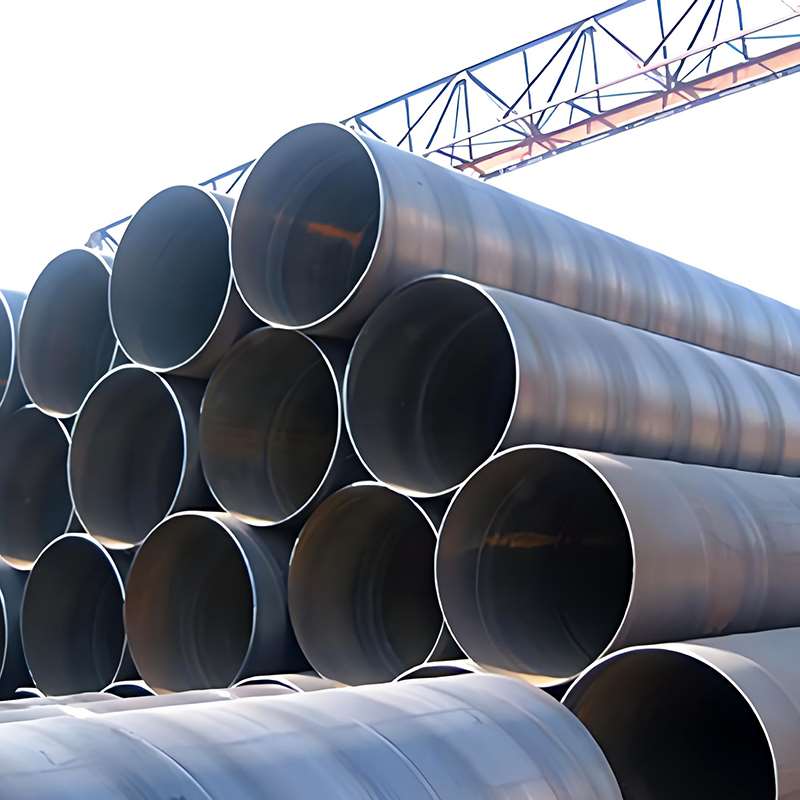
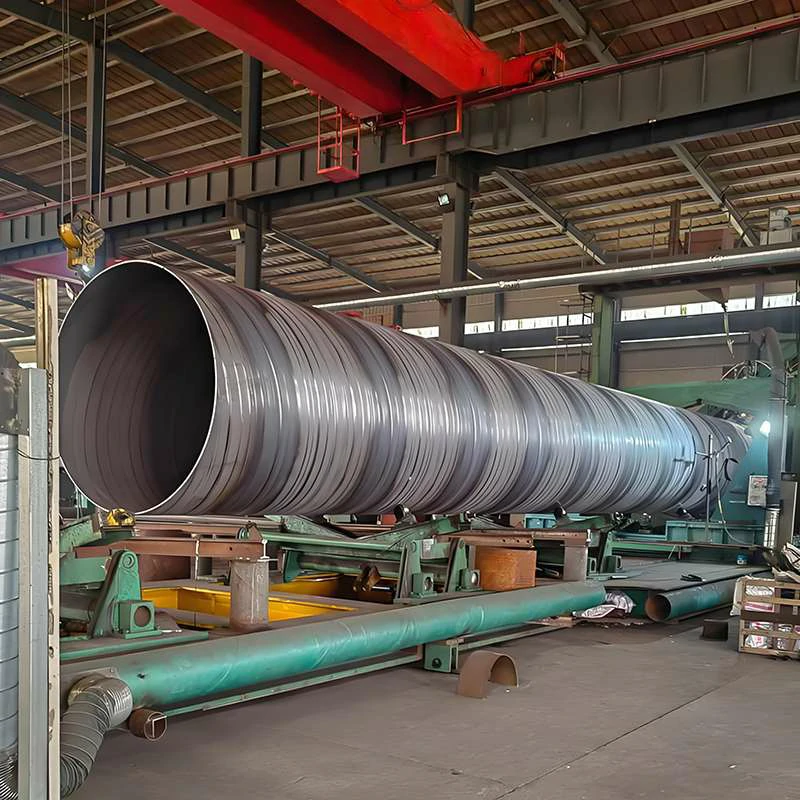
Using hot-rolled steel coils or strip steel as raw material, the strip is continuously formed into a tubular shape at a specific helical angle and welded along the spiral seam.
Key Advantage
This process eliminates the traditional limitation imposed by raw material width.
By adjusting the forming angle, manufacturers can produce a wide range of pipe diameters using the same coil width.
Economic Benefit
Steel coil production is highly mature, with abundant market supply and large-scale manufacturing capacity.
As a result, the raw material cost of SSAW pipe is substantially lower than that of ultra-wide heavy steel plates.
This inherent raw material advantage immediately places SSAW steel pipe in a more competitive pricing position.
2. Higher Production Efficiency Through Continuous Manufacturing
Large-diameter LSAW pipe is typically manufactured on a non-continuous, pipe-by-pipe basis.
The production process involves multiple steps, including:
- Edge milling
- Plate pre-bending
- Forming
- Internal welding
- External welding
- Mechanical expansion
These processes result in relatively long production cycles.
By contrast, SSAW pipe is produced on a fully integrated continuous production line incorporating:
- Coil uncoiling
- Leveling
- Edge milling
- Forming
- Welding
- Flying cut-off operations
As long as sufficient coil material is available, the production line can continuously manufacture pipe with exceptional efficiency.
This significantly reduces equipment depreciation costs, labor expenses, and overall manufacturing overhead, ultimately resulting in a lower ex-factory price per ton.
II. Optimization of Structural Mechanics and Material Utilization
1. Eliminating the Costly Mechanical Expansion Process
Because residual stresses in LSAW pipe are often unevenly distributed after forming, a critical process known as mechanical expansion is typically required to achieve dimensional accuracy and roundness.
Large-diameter expansion equipment often represents investments of tens or even hundreds of millions of yuan and consumes substantial energy.
SSAW pipe, however, is formed through a gradual spiral rolling process that produces a more uniform residual stress distribution.
The pipe naturally maintains excellent roundness, often eliminating the need for high-energy mechanical expansion altogether.
This directly removes one of the most expensive manufacturing stages associated with large-diameter pipe production.
2. Spiral Weld Geometry Improves Stress Distribution
From a mechanical perspective, internal pipeline pressure generates its highest principal stress—known as hoop stress—perpendicular to the pipe axis.
For LSAW pipe, the longitudinal weld is positioned directly within the direction of maximum hoop stress.
For SSAW pipe, the weld follows a helical path around the pipe body.
As a result, the combined stress acting on the spiral weld is typically only 60% to 85% of the maximum principal stress experienced by a longitudinal weld.
Practical Implication
Under identical operating pressures and using the same steel grade, SSAW pipe can often be designed with a thinner wall than LSAW pipe while maintaining equivalent safety margins.
For example:
In a large water transmission project:
- LSAW pipe may require a wall thickness of 14 mm
- SSAW pipe may require only 12 mm after detailed engineering analysis
A reduction of 2 mm may appear minor, but for large-diameter pipelines it can save dozens of tons of steel per kilometer.
The resulting material savings can be substantial over the life of a major project.
III. Construction and Logistics Advantages Through Flexible Length Customization
1. Longer Pipe Lengths Reduce Field Welding Requirements
Due to limitations associated with steel plate dimensions and forming equipment, standard large-diameter LSAW pipe lengths are typically limited to 12 meters.
SSAW pipe, by contrast, is manufactured through continuous forming and cutting processes.
In theory, almost any length can be produced, with practical limits primarily determined by transportation regulations.
Typical transportation limits allow:
- 15–18 meter lengths for domestic overland transportation
- Even longer lengths for waterborne transportation
Cost Comparison Example
Consider a 30-kilometer DN1200 pipeline project.
Using 12-meter pipes:
- Approximately 2,500 field joints are required
Using 15-meter SSAW pipes:
- Approximately 2,000 field joints are required
This eliminates roughly 500 field welds.
Since large-diameter field welding, automated non-destructive testing (X-ray or ultrasonic inspection), and field joint coating are all expensive operations, reducing hundreds of weld joints can significantly lower labor costs, equipment rental expenses, and project timelines.
2. Flexible Coating Options Reduce Lifecycle Costs
Large-diameter SSAW steel pipe can be conveniently coated on automated production lines before shipment.
Common coating systems include:
- 3PE (Three-Layer Polyethylene Coating)
- Internal and External Epoxy Coating (IPN8710)
- Cement Mortar Lining
Because SSAW pipe presents a continuous and uniform surface geometry, coating systems can be applied efficiently and economically.
In many cases, automated coating costs are lower than those associated with heavy-wall LSAW pipe.
IV. Total Lifecycle Cost Comparison
To illustrate the economic advantages more clearly, consider a large-scale water diversion project in China with the following parameters:
- Pipe Diameter: DN1400
- Design Pressure: 1.6 MPa
- Pipeline Length: 10 km
The following comparison summarizes the overall project economics of SSAW and LSAW pipe.
| Evaluation Factor | SSAW Steel Pipe | LSAW Steel Pipe | Cost-Benefit Analysis |
|---|---|---|---|
| Raw Material Cost | Approx. RMB 4,200–4,500/ton | Approx. RMB 5,200–5,800/ton | SSAW pipe is typically 15%–20% lower in material and manufacturing cost |
| Design Wall Thickness | 12 mm (optimized stress distribution) | 14 mm (weld subjected to maximum principal stress) | SSAW pipe reduces weight per meter by approximately 14% |
| Single Pipe Length | Customizable up to 15 m | Standard 12 m | For a 10 km project: approximately 666 joints vs. 833 joints |
| Field Welding & NDT Cost | Lower (about 20% fewer joints) | Higher (more frequent welding and inspection) | Significant savings in labor and equipment rental |
| Total Initial Project Budget | Baseline Cost (100%) | Approximately 135%–145% | SSAW pipe can reduce pipeline investment by nearly one-third in large-diameter projects |
V. Practical Procurement and Engineering Considerations
Although SSAW steel pipe offers outstanding cost-effectiveness for large-diameter applications, realizing these benefits in practice requires careful attention to several key factors.
1. Select the Appropriate Standard Based on the Service Medium
For low-pressure fluid transportation applications such as:
- Municipal sewage systems
- Slurry transportation
- Foundation piling
SY/T 5037 is generally sufficient and provides the most economical solution.
For more demanding applications such as:
- High-pressure water transmission
- Natural gas distribution
- Oil and gas pipelines
Tender specifications should clearly require compliance with GB/T 9711.
This standard imposes stringent requirements on:
- Weld misalignment tolerance
- Non-destructive testing
- Overall manufacturing quality
Attempting to reduce costs by using lower-grade specifications for hazardous service conditions can create significant safety risks.
2. Control the Economic Impact of Negative Thickness Tolerance
Industry standards permit certain negative wall thickness tolerances.
When requesting quotations, relying solely on nominal wall thickness can lead to misleadingly low prices.
Contracts should clearly specify whether delivery is based on:
- Net wall thickness requirements, or
- Weight-based settlement
For large-diameter projects, weight-based settlement is generally recommended to ensure that payments accurately reflect the actual amount of steel delivered.
3. Pay Attention to Weld Reinforcement During Coating Installation
SSAW pipe contains a raised spiral weld seam.
During field joint coating using heat-shrink sleeves or similar systems, small voids can sometimes develop around the weld reinforcement area.
During site inspection and acceptance, particular attention should be paid to weld reinforcement height.
Industry practice typically limits weld reinforcement to:
No greater than 3 mm
Proper control helps prevent coating defects and minimizes future maintenance costs associated with corrosion protection failures.