
When sourcing spiral steel pipes from China, many international buyers face a classic dilemma: Should they deal directly with manufacturers or go through a trading company?
Many people instinctively assume that manufacturers—who “cut out the middleman”—are definitely the better choice, but in the steel pipe import-export trade, this conclusion is not always true. Due to their large size, heavy weight, and strict technical standards (such as API 5L and ASTM A252), spiral welded steel pipes are often used in large-scale projects such as water supply, pile driving, dredging, or oil transportation. The choice of supplier depends on the size of your order, your technical customization needs, and your supply chain management capabilities.
Below is a comparison of the key differences between the two options, which we hope will help you make a sound business decision.
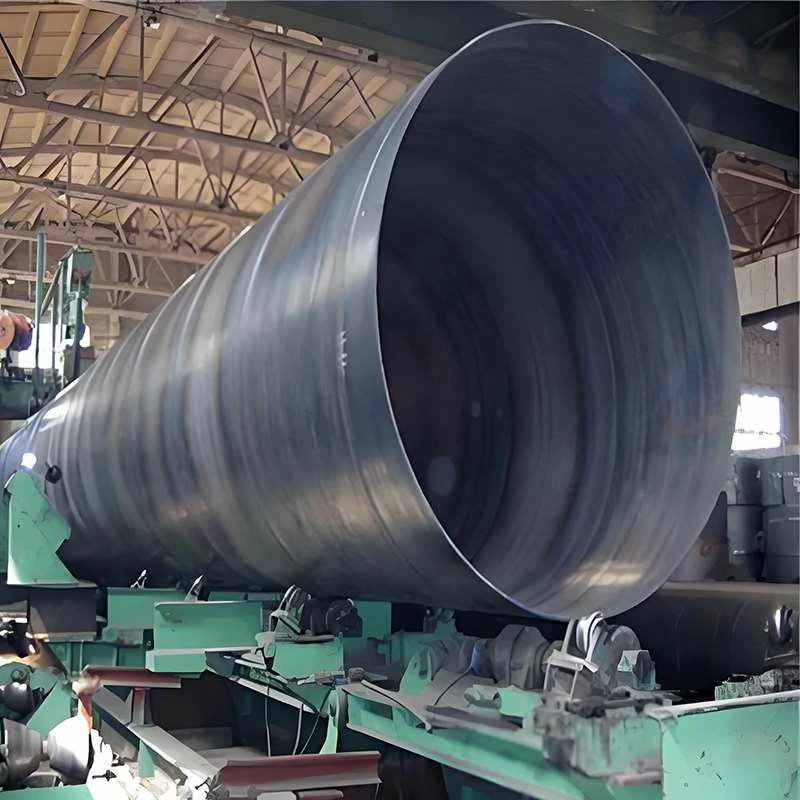
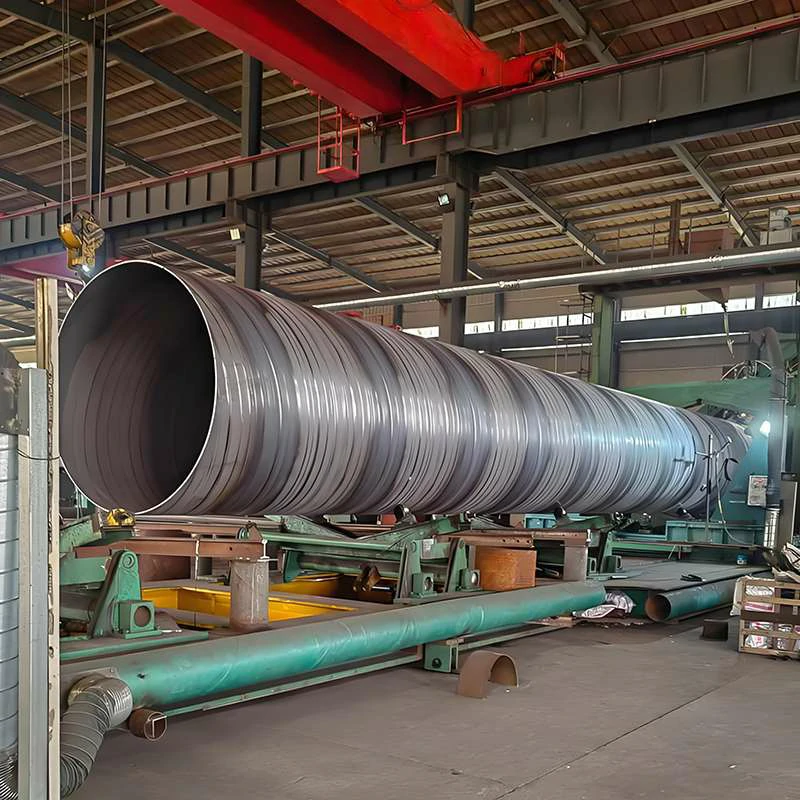
I. Comparison of Chinese Spiral Steel Pipe Manufacturers vs. Trading Companies
1. Pricing and Minimum Order Quantities
Manufacturers: They offer price advantages, especially for large-volume orders. Manufacturers’ quotes are calculated based on raw material and processing costs. However, the downside is that they require high minimum order quantities. If your project only requires a few metric tons or small batches of steel pipes with many different outer diameters and wall thicknesses, manufacturers are generally unwilling to adjust their coil unwinding and forming lines for such small volumes.
Trading Companies: Unit prices are typically 5% to 20% higher than those of manufacturers (depending on their profit margin). However, trading companies usually offer a high degree of flexibility. They collaborate with multiple factories year-round and can consolidate orders from several small buyers or directly source products from the factories’ spot inventory, allowing them to accept lower minimum order quantities.
2. Product Variety and Supporting Services
Manufacturers: Specialization is key. A spiral welded steel pipe manufacturer may focus on producing pipes within a specific diameter range. However, if your project requires seamless steel pipes, straight-seam submerged-arc welded pipes, pipe fittings, and special 3PE anti-corrosion coatings, a single manufacturer often cannot produce all of these in-house, forcing you to negotiate separately with multiple manufacturers.
Trading Companies: Trading companies are experts in “one-stop procurement.” They can help you bundle the procurement of spiral-welded pipes, anti-corrosion treatments, and配套 valves and flanges, consolidating them into a single container or bulk carrier for shipment. This saves you significant costs in communication, logistics, and customs clearance.
3. Technical Communication and Engineering Customization
Manufacturers: If your project has stringent technical specifications (such as requiring 100% ultrasonic non-destructive testing (NDT), hydrostatic pressure testing, or custom steel grades like X70), dealing directly with the factory is the best option. You can communicate directly with the factory’s quality control (QC) engineers to adjust production processes, eliminating “information delays” caused by intermediaries and minimizing the error rate.
Trading Companies: Since trading companies do not control the production line, they can only act as “messengers” when dealing with complex, customized technical drawings. Any miscommunication can easily lead to deviations in the finished product’s specifications. This can be fatal in engineering projects.
4. Language, Logistics, and Foreign Trade Compliance
Manufacturers: Many large domestic steel pipe manufacturers in China are more adept at domestic production and sales. Their foreign trade teams may have limited experience, lack fluency in English, and may not handle complex international logistics, chartering, booking cargo space, and special customs clearance documentation for destination countries as smoothly as they should.
Trading Companies: The vast majority of trading companies have experienced, elite teams. They respond quickly, are fluent in English or other languages, are familiar with international ocean freight, can help you avoid risks such as rust and deformation from collisions during transit, and can handle complex import and export documentation.
II. Key Considerations: Who Should You Choose?
To help you evaluate your options more intuitively, let’s take a look at this decision matrix:
| Procurement Pain Point / Project Feature | Recommended Choice | Core Reason |
|---|---|---|
| Large infrastructure projects (orders > 100 tons, single specification) | Manufacturer | Significant economies of scale can directly reduce large amounts of intermediate costs. |
| Small orders or multiple specifications (requiring mixed quantities and various sizes) | Trading Company | Many manufacturers do not accept small orders, while trading companies can provide flexible inventory allocation and mixed shipments. |
| High standards and customized requirements (requiring API certification, special inspection, etc.) | Manufacturer | Direct quality control, fully transparent production process, and clear responsibility allocation. |
| Multi-category bundled procurement (steel pipes + anti-corrosion coating + valves and fittings) | Trading Company | Strong supply chain integration capability, avoiding the complexity of coordinating with multiple suppliers. |
| Lack of import experience (first-time purchasing from China, concerned about operational difficulties) | Trading Company | Provides comprehensive international logistics support and customs clearance documentation services. |
III. Guide to Avoiding Pitfalls: How to Identify Fake Factories?
On Alibaba, Made-in-China, or Google, almost all suppliers claim to be “Manufacturers.” To ensure you’re dealing with a genuine partner, you can use the following methods to verify their legitimacy:
- Check the business license: A manufacturer’s scope of business typically includes terms such as “production,” “manufacturing,” or “processing” (e.g., steel pipe manufacturing, pipe processing); whereas the scope of a pure trading company usually involves “sales,” “trade,” or “import/export.”
- Check Product Focus: If a supplier’s store sells spiral steel pipes, stainless steel screws, and safety helmets all at once, it is undoubtedly a trading company. Genuine spiral pipe manufacturers focus exclusively on steel products or pipeline-related items.
- Request a Video Factory Tour: Before signing a contract, ask the supplier to conduct a live video call from their production floor. Have them point the camera at the forming lines, welding stations, or the sign hanging at the factory gate—the truth will become immediately clear.